Tag Archives: expectations

Sure, the ‘MEternity’ Leave Idea Seems Idiotic… But I Can’t Really Blame its Author

Meghann Foye has been getting a lot of attention for her NY Post piece about wanting her own ‘maternity’ leave without having any kids… called a “MEternity leave.” Granted, this is probably just a publicity grab for her new book, which I have no opinion on as I haven’t read it, but this piece alone is getting quite the reaction from parents, who are largely outraged at her insinuations that parental leave is an opportunity to obtain lifestyle flexibility, time for self-reflection, and a renewed sense of self-confidence if you’re burnt out at your workplace.

“Ha. HA. HAH!,” yelled, in unison, all parents who read this ignorant, unicorn pipe dream.

There have been some hilarious and cathartic responses written to Foye’s piece, like this one at Scary Mommy and this one over at Yackler Magazine. Both of these take Foye’s proposed ideas down with wit and acuity. Read them!

I can’t, though, in all honesty, attack Foye myself. Because deep down, I know I was not devoid of similar thoughts about maternity leave… BEFORE I had kids. And I know I’m not the only one who had wildly inaccurate, ridiculous, idiotic notions about what maternity leave would afford me as a new parent: Continue reading

When I was Disappointed by My Child’s “Gender”

With my first pregnancy, I really wanted the sex to be a surprise – after all, it’s the one major surprise in life you know is going to be wonderful either way, right? I got a thrill imagining all the possibilities of who my little unborn person could be, without gendered boundaries. I was thrilled when my son was born – I saw him on the bed below me and immediately squealed, “Oh my god, he’s here!” I tried to pick him up so fast the midwives had to stop me so I wouldn’t yank the cord.

My second pregnancy was an entirely different story. As you may know from a few of my other posts, I’m a feminist. I believe strongly in deconstructing the patriarchal values that disadvantage people who aren’t heterosexual, cisgender males in our society. So perhaps it won’t surprise to say I always hoped I’d have a daughter. I envisioned a young woman who I could raise to be a strong bulwark against the bullshit of the patriarchy, someone who would resist gender stereotypes and prove “the man” wrong with her intelligence and independence. My husband hoped for the same. We only plan on having two kids, so suddenly the sex of this little person had more at stake, and we decided to find out at the 20-week ultrasound. We’d heard enough stories of people who’d been disappointed with a baby’s sex, so finding out in advance seemed like the safer option.

When the ultrasound technician pronounced the fetus male, Continue reading

The Thing I Sometimes Forget About Professional Advice

This past week, I struggled with feeding my son. He didn’t gain as much weight as they would have liked, so I was advised by the midwife who came to visit me that I needed to feed him every 2 hours.

I did so for two days, and described to another midwife who came next to re-weigh him how a 2-hours system allowed him very little sleep, since he took a long time to feed, and then didn’t have much time to sleep before I had to wake him up again and try to force him to eat once more. (Before I started forcing a feed every two hours, he was sleeping four-hour stretches each night, so I’ll admit, it also just felt in violation of every instinct to wake a sleeping baby in the middle of the night when I’d been handed such good fortune!) She said I could feed every 3 hours instead, and maybe allow a 4-hour stretch once per night.

Two days later, this seemed to be just as bad a situation as every 2 hours, and I called the midwife paging service, hoping for some additional advice since I felt stressed out. It felt like our day was just an endless cycle of me forcing him awake, trying to force him to eat even though my breasts didn’t feel full yet, him sleepily not eating a whole lot, him being more awake in between attempts to latch him but then mostly just falling back asleep on the boob every time we returned to it. Then we’d start the whole cycle again after about 40 minutes of sleep. I had no idea what my kid’s natural rhythm was so I wasn’t even sure where to start on getting us into something that felt better.

Midwife #3 listened, then had a completely different response: “Stop waking him up,” she said. She explained why, based on everything I’d told her about our experience and my son’s health thus far, it would be okay to try for a few days going with his schedule, letting him decide when he would eat. If that worked and he still gained weight at the next re-weigh, then we had our answer. If he didn’t gain as much as they’d like, then we’d address it then, and that would be fine, too, since the next visit was only two days away.

If Plan A doesn't work

When seeking expert advice, I’ve always personally felt going to a professional seemed the safest bet – after all, the profession would have equal training across its population and a set of ‘best practices,’ wouldn’t it? The thing I seem to forget sometimes is that professionals are, in fact, a group of individuals like any other group – which means each individual brings their own experiences, preferences, and beliefs to the table in the context of their professional training.

Oddly, I seem to continually forget this each time I seek professional advice, despite the fact that with everyone ranging from physiotherapists, doctors, midwives, teachers, and mortgage brokers, I’ve had personal experiences where one professional will confidently tell me is what needs to happen, only to have the next professional tell me to forget everything I’ve heard about x, because is what needs to happen. Yet when I first hear x, I obediently latch onto the instructions and follow them as closely as I can. Then when I hear y, I get stressed about why I’ve been doing x so far instead.

But this isn’t a flaw in the professionals, or a suggestion that they don’t know what they’re talking about, or an implication that some are right and some are wrong. It’s a reflection that when seeking advice, I really have to take everyone’s with a grain of salt – even from a professional – and allow that one person’s advice is based on a specific combination of training, case experience, personal values and individual conclusions they’ve reached as a result of all those things combined.

I also have to remember that any piece of advice isn’t guaranteed to work, even if it comes from a professional, because my kid (and me) are also individuals bringing other factors into the equation. It would be more comforting to have consistent advice from all professionals in the same field, to not have such things as ‘second opinions.’ But if the problems we brought to professionals were that simple, we wouldn’t need professionals at all – there would just be one standard instruction book for Renovate Your Kitchen or DIY Therapy or Raise Your Child and one size would fit all.

Remi sleeping

Turns out the third time was a charm for me and my kiddo. Following the final midwife’s advice did the trick – and after a day and a half of longer sleeps, my wee one started gravitating to 3 hours between feeds all on his own. I guess he just needed to reset and catch up on some of the sleep he hadn’t been getting first.

And, luckily, he still usually gives me one 4-hour stretch between nighttime feeds (phew!).

A Little Re-Frame Changes the Whole Picture

Sometimes we get stuck in ruts that suck. There is a certain situation or environment that is constant or recurring in our lives, and it sucks… worse, sometimes, we know we suck in it. Those circumstances that bring out the worst version of ourselves, but we can’t avoid them because they are necessary to our lives. They could be at work, at home, with relatives, with friends, or with our kids. My own awful circumstance that I’ve been re-thrust into this week is the Dreaded Newborn Night Wakings. My son was born one week ago (hurray! I’m finally done being pregnant!), and nighttime feedings are once again part of my routine (ahhh! I’m a terrible person when I’m tired!!).

Night wakings with a baby are the circumstance that brings out the worst in me. So re-entering this space (my older kid has been sleeping through the night consistently for several months now and it’s been blissful) suddenly sparked an all-too-familiar, trigger-happy, irritable anxiety that only manifests between midnight and 5am. In this space, an uncooperative support pillow lights a match of rage in my throat, and a refusal by my days-old child to immediately go back to sleep after a feed ignites the urge to throw a toddler-esque tantrum and whisper, “Fine! We’ll just sit up all fucking night then!” Like I said, I’m a terrible person when I’m tired. I long ago accepted this about myself, and always try to get enough sleep to avoid the monster coming out. This tried-and-true strategy of consistent bedtimes and eight hours of sleep is just not an option for the near future, unfortunately.

I’m sure (or at least I hope, even just so I can feel less terrible about it) that most of us have these situations – certain circumstances that get under our skin and change our reactions and behaviour for the worse. Yesterday, however, I decided to try to do something about it, and I was amazed at how calm and peaceful last night was as a result! So I’m feeling pretty great about it today and thought I’d share.

The first thing I did was re-frame the purpose of the situation. Instead of thinking about The Impending Horrible (night wakings) as drudgery, as simply a necessary, sacrificial duty of my life, I decided to think of them as a opportunity for long-term gain. As I imagine all parents of newborns are, I’m very invested in helping my son learn to sleep well, calmly, and most importantly, through the night. And as a second-time parent, I’ve already noticed myself being much more calm and collected during the day in moments that distress him as a newborn, than I was with my first. So if my son experiences me as calm and reassuring during the day, but as anxious and on edge during the night, he might learn that night is a time for being on high alert, for worrying about things – that nighttime, in short, is bad… which probably won’t help him feel at ease about sleeping through it. Keeping this big-picture purpose in mind helped me last night to stay calm throughout our feeding and awake time, even though I was just as tired as the nights before, and could have easily reacted in my old patterns.

The second thing I did was re-frame my expectations. I realized I had been going into each night waking hoping for the best (ie. that he would eat quickly and go right back to sleep) but focusing on and anticipating the worst (my exhaustion and the possibility that he would stay awake all night). I took a look at my baby tracker app, and noticed that his average time awake per instance at night, is around an hour to an hour and ten minutes. So my expectation that we would feed for thirty and then both be back to sleep was simply unreasonable. I was setting myself up for failure and irritation every time. Looking at the clock when he woke up last night, and expecting that I would be awake for up to an hour and fifteen minutes more, helped me to not feel anxious the whole time about when the feed would end, if he was eating fast enough, etc. And when he did go back down faster than that, it was a pleasant surprise instead. By being realistic about the crappy situation that I normally approach with wildly idealistic expectations but a sour, pessimistic attitude, the whole thing got a lot better.

I’m going to try to remember these two approaches to other situations that I find grating, irritating, or generally rut-like in my life. Because being calm and moving with what felt like a little more grace through this rut last night was not just easier on those around me (my son, but also my husband, who gets up with me at this stage to pass the baby to me, change his diapers when needed, help soothe him back to sleep, etc.). More importantly, it made me feel more in control of myself, instead of like the sleep-deprived monster I never seemed able to keep at bay before.

What about you, lovely readers? What are your ruts or your recurring, inner-monster-inducing spaces? How do you help yourself move through them as best you can?

My Problem with Parenting Books

My husband and I were saying over dinner last night that it would be interesting if people organized their bookshelves by the year each book was added to their collection. (Alphabetization-addicts, like Shannon here at Raise a Mother, don’t panic – I’m not actually doing it!) But it would be a neat way to see the progression of your reading habits – how topics, authors, or genres of interest have shifted over time. If we did this, our newest section would be dominated by Parenting Books.

Parenting Books Collection

My bookshelf happens to be ordered so all Parenting Books are in the same section as it is.

I’ve acquired some of these books as gifts, others as hand-me-downs, and a few I’ve bought. The main issue I have with parenting books as a category is that too often a parenting book reads as a ‘manual,’ and this is, frankly, bullshit.

One book on this shelf (I won’t name names), started out great – it was reassuring and soothing to me as an anxious parent who wasn’t getting any sleep, as it explained that all babies can smoothly be taught to sleep through the night, if only you take the correct steps. Hah hah! Hah! I can scoff in retrospect. Desperate as I was, though, I devoutly followed the instructions laid out for me so clearly and reassuringly by the serene-looking writer on the book’s cover. At first, it seemed like it might work, but within a few weeks, my son’s sleep and mine had both deteriorated significantly. We were worse off than we had been at square one. We gave up on the expert advice of the author, and upon returning to our previous situation, it suddenly didn’t seem so bad (so maybe this was a ‘win’ after all?).

Now of course, this book was a bestseller because its advice had clearly worked for many people – the person who gave it to me even swore by it from personal experience! But for some reason it didn’t work for my kid, and when I stop to think about it, it makes sense that it didn’t. Because the author doesn’t know my kid. How could I expect that she knows exactly what will make him fall asleep and stay asleep all night long?!

Our children aren’t products. They’re not manufactured. They’re not one-size-fits-all. If they were, wouldn’t somebody have already written the perfect manual for raising a “Child,” and wouldn’t we all just be given a copy from our doctor or midwife upon birth and sent on our merry way?

The problem is, manuals, tutorials, and clearly defined steps are the way of our world today. Need to know how to change the bulb in your car headlight? Speed read? Poach an egg? Do a complicated braid? Pose a selfie? There are video tutorials and listicles with step-by-step instructions on how to do all of these things, and everything in between. This can be great: you can save money on mechanic service, whip through required reading, make delicious breakfasts, satisfy a kid’s Frozen obsession, and avoid ever again publicly sharing a photo of the insides of your nostrils, all without too much risk, because probably, if you follow the instructions, these sorts of outcomes are fairly reliable (Pinterest fails aside, which are, incidentally, a delightful waste of Internet time).

Unfortunately, we’ve become so wired to expect the ability to just follow-the-instructions and get reliable outcomes, that this trend has spread to things that by nature just aren’t that reliable. So the web is also full of listicles and how-to-steps on things like personal relationships, finding self-worth, being happy, and yes, raising children. Wikihow, for example, whose tagline is “How to do anything” (really?) has a whole relationship section:

Wikihow relationships

I seriously question that a single article is going to be able to reliably “restore my faith in humanity” if it’s truly been lost. Life’s just not that easy.

Our kids are individual people, and working with them on complicated things like anxiety, adapting to change, or managing their emotions (which, quite possibly, are at the heart of some struggles like not being able to sleep through the night), is likely going to be a process of trial-and-error, just like it is working on these things with adults.  Assuming that a simple checklist of steps is going to ‘fix’ or ‘solve’ such complexities, or reduce the need for us to actually struggle through teaching a tiny separate person how to be in the world, just seems silly in this light.

So what books do I think are useful?

Well, some of the tangible advice ones are, sure. For example, I found great, clear ‘instructions’ and tips that fortunately worked out well for me and my kid in books like Solve Your Child’s Sleep Problems by Richard Ferber, or Baby-Led Weaning by Gill Rapley and Tracey Murkett. But I firmly believe now that these just happened to work for our particular context, our family, and our child, and I wouldn’t presume to tell another parent, “Oh, you definitely have to try this because it’s magic!” Sadly, I’ve heard too many parents express just this sentiment in real life and seen even more parents do so in the online blogging world. There is no one-size-fits-all magic – don’t believe it for a second, as glorious and reassuring as it sounds. If a particular tip or book works for you, embrace it and cherish it – just remember that this is a happy coincidence, and maybe let yourself feel a bit smug that you found your match, you lucky duck!

The books I’ve found the most useful, it turns out, are the broader ones. The ones that don’t claim to have any specific “answers” for the difficulties I’m facing, but instead encourage me to rethink my whole perspective on parenting, to allow myself to look beyond the scope of the particular irritation of the moment, to consider my kid and my relationship with him not as a collection of ‘symptoms’ to be addressed but in a more holistic way, for the long-term.

Yes, this requires more time to get through. It requires more time to sit and let the ideas sink in. It requires me to do the connect-the-dots work of figuring out how the bigger ideas presented fit into my life and my parenting ideas. It certainly doesn’t allow me to do a quick reference and fix a crisis in the moment. But it also has been, at least for me, a hell of a lot more effective to actually making change that feels better in my house, my family, and my life.

Now I know you might be thinking, really, Lindsay, that’s the end? Thanks for nothing helpful today... so hopefully I can make that better. This is sort of a two-part blog, because my next post is going to describe the two books I have personally found most useful, and how I have found them to be great companion books for one another. So in case you’re looking for some interesting reads on parenting, but like me, you’re disillusioned with the ‘manual’ approach, stay tuned! I promise to give you more.


3 Reasons I’m (Mostly) Ignoring My Due Date

A pregnant woman’s due date can mean a lot. It’s the standard question she gets from strangers. Inputting it online procures alerts about what fruit or French pastry her baby resembles in size each week. It charts her ‘progress,’ determining the topics of each medical appointment and when she can have that long-awaited ultrasound. It’s how she plans her last day at work or a baby shower. It might even be the same as a holiday or a friend’s birthday, which can heighten its excitement. It helps to prepare for a MAJOR event in her life.

So why am I trying to ignore this important date the second time around?

Well, with my first child, my due date was 8 days after my sister’s due date, which was VERY. FREAKING. EXCITING. I cannot stress that enough, seeing as these were not only first babies for both of us, but first grandchildren in our family. Our joint family baby shower involved a decorated calendar where everyone placed bets on when each baby would be born, and there would be prizes! Throughout our pregnancies, our symptoms were almost like clockwork.  What she experienced one week, I would a week later. It was wonderful to share all those details with someone whom I knew got exactly what I was talking about.

Then my nephew was born – 10 days early. So naturally, once he had made his arrival, my brain went into hyper-anticipation-readiness mode: That means it’s only a week until I go into labour!!! Of course, in the way that it does, reality kicked my expectation-having ass with nearly another month of waiting. Our boys’ birthdays are 27 days apart.

So while due dates are all very well and useful for some things, here are the three reasons I’ve been thinking of a ‘due month’ this time around:

3 ReasonsI'mIgnoringMyDue Datethe 2ndTimeAround

#1. It keeps everyone else’s (completely understandable and unintentional) pressure at bay… which helps me to feel less stress. 

When asked with baby #2, “When are you due?” my most common response has been “Not until the end of March,” or “Sometime late March/early April.” No one’s really been counting down the way they were the first time (including me!), which has reinforced in my own head that there is no reliable countdown to do, so therefore I don’t stress about it. Sure, it was a little embarrassing at prenatal yoga to be the only one in the circle who usually couldn’t remember how many weeks along she was, but it’s been kind of nice when even close friends ask casually, “So wait, when’s your  actual due date again? I forget.”

#2. I can truly enjoy the early days of mat leave this time around.

With my first pregnancy, I was a bundle of nervous excitement from the moment I left work on my last day. The nine days I went past my due date were the most impatient I have ever known, as each day I woke up thinking, surely it’s got to be today!  I expended most of my energy trying every natural induction remedy in the book: massage, stretch and sweeps, spicy food, hours of bouncing on an exercise ball, copious amounts of red raspberry leaf tea, as much sex as I could get my body positioned for, and as long and brisk walks as I could handle at a 40-week waddle. Also, certain that the wee lamb was going to come by his due date (if not early!), I had long checked off my to-do-before-baby-comes list. I was impatient to start using all those clean baby clothes and strapped-in carseat, not to mention eating the delicious freezer meals my mother-in-law had stocked in my kitchen. This time, I’ve been off work for a week and there are still things on the to-do list that haven’t been done, but I figure I’ll never know when it’s down to the wire, and it could still be weeks away, so why not just take a walk, get a pedicure, or read a book for now?

#3. It turns out maybe it’s not possible to know when your ‘due date’ should be, anyway.

A recent study on women’s gestational length suggests that why babies don’t generally come on their ‘due dates’ might have less to do than previously thought with errors in calculation or inability to pinpoint when conception actually took place. Instead, the study found that even when you know exactly when a woman conceived, the length of a normal, healthy pregnancy still varies by as much as five weeks. Five weeks! Knowing this last time, instead of thinking that babies who don’t come on their due date are either ‘early’ or ‘late,’ probably would have kept me from some of my impatience and stress about it. Medical issues aside, I imagine the same could be said of mothers whose babies come ‘early,’ and so they may have different worries or stress as a result. When I think about it, it makes sense that there would be this much variation. Women are all different, our bodies are all different, and our babies and experiences of motherhood are certainly all different, so why would we expect pregnancy length to be an exception? Maybe this is just another (small) example of how we can do better on accepting our diversity as women and mothers, rather than feeling pressure to fit into some standard mold.

So if you want to love your due date, love it. If you want to live by it and build to-do lists around it, power to you! But if it ends up stressing you out, making you impatient, or causing unnecessary worry about being ‘early’ or ‘late,’ then perhaps remembering that a ‘due date’ is really more of a ‘due month’ might help.


Parenthood is Not a Project

I’m re-reading my favourite parenting book: Bringing Up Bebe by Pamela Druckerman. This is the third time I’ve read it in under three years, and I love it because it’s funny, it’s relatable, and each time I read it, I’m struck by new things. So don’t be surprised if I bring up Druckerman’s ideas in more blog posts in future.

Today I was reading her chapter on “The Perfect Mother Doesn’t Exist,” where she talks about how American-style (and I’d say, Canadian-style, too) parenting involves an intense amount of “concerted cultivation” – in other words, parenthood is a project. Druckerman admits that as an American living in Paris, “my project is to make my kids bilingual, international, and lovers of fine cheese.” It struck me that perhaps one of the reasons I had great difficulty during my first maternity leave is that I too, thought of my time at home as a project.

I’m not surprised I viewed mat leave this way. Most of my life until that point had been a series of projects – from completing each class and each year of education until I was 22, and then continuing that ‘project’ mindset as I moved on through a series of contract jobs, buying my first house, and the nine months of my first pregnancy. All these experiences had definitive expiry dates, finish lines, and clear goals.

So of course I saw mat leave, with it’s defined months – six, in my case – as another project. I had an actual spreadsheet of goals, and I thought I was being very reasonable to only put one major item on the slate for each week. This didn’t work out so well for me. I did manage to check off most of my goals (probably because I had been so minimal with them in the first place), but I still felt like I hadn’t managed to accomplish much as my return to work neared.

Looking back now, I realize the problem wasn’t that I had tried to be organized, or that I had tried to ‘make the most’ of my brief time off work by having a clear idea of what I wanted to accomplish. The problem was that the point of that time wasn’t leave from work. The point of that time was my entrance into motherhood. I had been thinking about those six months as an isolated block of time, rather than as just the beginning of a lifelong experience with no expiry date, no finish line – the experience of being a parent.

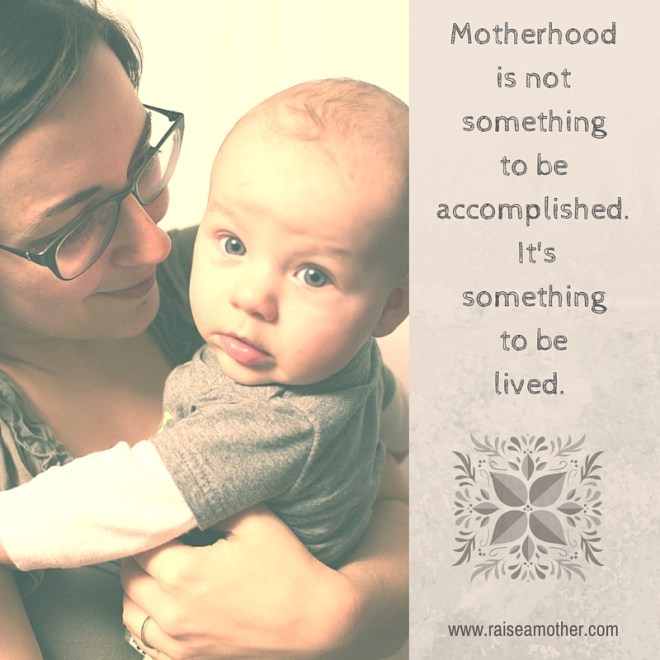
Of course I felt I hadn’t “accomplished” anything – because my relationship with my child, my motherhood, my family, isn’t something to be “accomplished.” It’s something to be lived.

This isn’t to say I can’t have goals while I’m away from work this time around – I can, and I probably should, to keep connected to my independent adult self, who loves to-do lists and accomplishing things. But I won’t tie those goals to the finite period of my mat leave; instead, they’ll just be part of my life while I happen to be home every day, and they can and should go beyond my return-to-work date.

As I thought about this, I set aside my book, rubbed my big round belly, and promised baby #2 that this go round, our time together won’t be a project. We won’t try to accomplish things over the next year. We’ll just experience living with each other, getting to know each other, and cherish the fact that we have so much time to devote to the start of this new relationship that will last forever.

Motherhood is not something to be accomplished. It's something to be lived. (1)


Bonding – a Whole Approach to Life

I recently read this beautiful essay on how human connection – not sobriety – is the remedy for addiction. I highly recommend reading the whole thing, but if you aren’t going to, I’ll try to snapshot the key points that have sparked my thinking here:

The author, Johann Hari, explains two separate addiction experiments done with rats, the long and short of which is that the rats who were kept in isolated, un-stimulating environments were exceptionally prone to drug addiction, but those who lived in ‘Rat Park,’ a healthy, happy environment for rats, were not. Moreover, once rats who had been conditioned to addiction in the isolated cages were allowed to live in Rat Park (“a lush cage” with “colored balls and the best rat-food and tunnels to scamper down and plenty of friends”), they quickly returned to a life free of drug use. He goes on to make comparisons to human examples of Vietnam-war veterans and those prescribed heavily-addictive drugs in hospital settings, which are quite interesting.

But my thought-train here has really nothing to do with addiction per se, or with rats, or with the ethics of animal experimentation. Rather, one of Hari’s passages struck me particularly:

“Human beings are bonding animals. We need to connect and love. […] But we have created an environment and a culture that cut us off from connection, or offer only the parody of it offered by the Internet.”

His argument is about addiction as a clinical condition, but I think his assessment of human beings is something we can all reflect on and learn from.

While not in as dire circumstances as many people, there are many of us living what appear on the surface, or from the outside, to be ‘full’ and ‘happy’ lives… or at least what ‘should’ be so. In truth, many of us live in self-constructed cages of isolation. Even if we’re not facing depression or constant physical isolation, we’re often more isolated than we would like to be. Why is that, especially if we are lucky enough to in fact have the means, the people nearby, and the opportunities, to be more connected, more bonded with our village?

Too often it seems we feel we don’t have the time to connect with our people, our friends and family; this is the most common cause I hear. But what are we doing instead? The usual culprits seem to be working, getting chores done, driving around to do errands, with the awful end result that when one does have some ‘free’ time, it needs to be ‘me’ time (read: a chance to collapse from exhaustion, to sleep or zombify in front of a screen).

But I think in these cases we need to question the importance of the things we’re using our time for instead of connecting – because at the end of the day, we are choosing to do so, and only by acknowledging our own agency can we start to either change it or become okay with it.

Do our living spaces really need to be tidy in order to enjoy our home with those we love? Does our time need to be ‘free’ of obligations or to-do lists before we can engage with our people? Or would it be better if we did more things communally – buying food, cooking, folding laundry – embracing that we’re all going through this together, rather than feeling we need to ‘get our shit together’ before we can enjoy one another’s company? Do we really need to ‘unwind’ at the end of a long day by scrolling through a social media feed that only gives us that ‘parody’ of bonding? We could instead be actually connecting with the people and activities that bring us joy, or indulging in that ‘me’ time by having a bath, walking outside, or doing an activity that engages our bodies and minds rather than just collapsing from exhaustion, often in front of a screen?

We have created a culture, as Hari says, “that cuts us off from connection.” The expectation is that we will all live in our own little kingdoms, whatever your particular box of living space looks like, and that our first responsibility is to keep our own kingdom in order. If we are good at keeping this order – bringing in the right amount of money for our lifestyle, tidying and cleaning, having the ‘right’ groceries in our cupboards with our near-future meal plans settled, having at least some plans in the works for how we’ll change our kingdom/life, and maintaining whatever image we’ve created of our lives in our online worlds – then we can occasionally, when it’s a ‘good’ time, invite others into our kingdom to enjoy the space we’ve cultivated, or allow ourselves some time away from our boxes to enjoy someone else’s kingdom… provided they have kept their kingdom in order, of course.

Perhaps we need to start living with each other, instead of alongside one other with the occasional meeting in the same space.

The people we wish we bonded more with might live in the same space as us, our spouses or children; they may live down the street or across town or across the country or the world, and technology may be a necessary tool for allowing us to simulate face-to-face interactions with some of them. We may wish to bond more with ourselves, to connect with our interests, and hobbies, those experiences that allow us to feel more alive, more engaged and joyful.

The point is not how we connect but whether the connection, the bonding, is a real bond or a parody. Even more so, the point is accepting our own agency (should we be so fortunate as to have some, as there are many in the world who truly don’t), so that when we feel we’re living in a cage, we can look around and determine honestly if the bars are real, or if we’ve given them form and weight with our own perceptions.

“Bonding” in this broader sense doesn’t seem to be something that can be done or felt effectively if only allotted in rare, discrete blocks of time; such a model means there will also be set times of isolation, boredom, or loneliness. It would be idealistic to think all of life will be continuous bonding and connection, but it also seems sad and unnecessary to resign ourselves to a life plan where bonding and connection are rare ‘treats’ if we’ve been ‘good.’ I’m not sure what the solution is, but I think it’s worth some serious consideration, and I hope some of you will leave your thoughtful comments below!

Letter to My Postpartum Self

If you’ve read this blog before, you might have come across my account of the dark, twisty postpartum period I had the first time around that caused my current, second pregnancy to, well, basically scare the shit out of me. Fortunately, I’ve had time to reflect, talk this fear out, and hear some wise words from other mamas in my village. Still, I know it’s easier to keep hold of these calming thoughts while Mister Baby is still in my belly than it might be once he’s out here in the world and my postpartum hormones mix with sleep deprivation in a toxic brew of negativity. So this letter is not only for me, to come back and hold onto in any twisty moments I might find in the year ahead, but also for any mamas out there who are in the dark place now, or who are pregnant and worried about moving into the dark once their baby arrives. Much love to you.

Dear Mama,

I know things are difficult right now. That things may seem like they’re falling apart, or that all your preparation has been for nought, or that you don’t even recognize who you are anymore, or maybe even all three at the same time. You may be questioning core things about yourself, your abilities, your judgment, your life, your partner, and not believing there could ever be a time where this uncertainty ends. All I can tell you is that even though you can see no light at the end of the tunnel, there is a lightI promise. I’ve been down this road before, and so have mamas since time immemorial. But I know that right now this seems like cheap platitude, so here are some thoughts for while you wait for that little light to appear and grow larger:

Hormones

They are rampaging right now, and are extraordinarily powerful, so don’t discount them. Remember those horrible adolescent years where you didn’t know what to do, or who you were, or how you were ever going to get to where you wanted to be? Same thing in early motherhood. This is hormones mixed with being thrown into the deep end of new expectations and new experiences, while striving for independence and a sense of accomplishment within this new angle of what it means to be a woman. But remember those wonderful teenage years where it seemed like everything might turn out a moony fairy-tale after all, and you couldn’t wait for all the fantastic experiences that were certainly ahead of you? This is early motherhood, too. This is hormones mixed with the delight in your little one’s smiles, snuggles, and that unbelievably good baby-smell.   So it’s a roller coaster, but a roller coaster you’re riding with a blindfold on. To pretend you’re taking a train ride, or to feel as if you should have been able to predict that next rise or fall, is ridiculous. You can prepare a bit, but some days, a fall you didn’t expect will still knock the wind out of you. When this happens, you don’t need to justify why – you’re on the roller coaster, that’s why.

Feelings

Similar to hormones, these are only sometimes things you have any control over, and they come in waves. Sorting out whether this particular rage about some unfinished laundry is the result of today’s emotional tsunami or a legitimate, last-straw outburst you would have had in the pre-baby days will be difficult. So if you think something specific or tangible is causing your melancholy or exasperation, notice it, but wait until the wave passes to decide how to move forward. Never be afraid of identifying a feeling, or admitting that you don’t know where it’s coming from, or that it’s overwhelming you. This is not a failure of rational thought – this is rational thought, because you’re recognizing the reality of your situation. The incoming tide will eventually stop, and you’ll be back to the emotional levels you’re used to handling as a reasonable adult.

Your Body

After birth it will be yours again, but not yours. You will still be attached to your babe for most of the day. You will not look like your pre-pregnancy body, at least not for awhile. You will not have your libido back, perhaps not for a much longer while than you find acceptable. You will be exhausted, at first from the experience of birth and its initial recovery, and then from carrying your wee one in your arms instead of in your belly, from night-wakings and extended periods of crying (from you or your little one). This is okay. Motherhood and marriage/partnership are long games, and you have time to adjust. There is no need to freak out about where you are 6-weeks, 3-months, or 8-months down the road from the birth day, or worry that this is where you’ll be forever. It isn’t.

10553883_10102005630891900_7139848070279818814_o

Housework

Acknowledge your role as a new mother, and not, unless this is your long-term plan, a ‘stay-at-home parent’ (even if this is your plan, give yourself some time to just be a new mom first). Keeping your baby alive and yourself sane can be a full-time job in itself, with simply no room in that job description for ensuring a tidy living room, kept-up laundry, made beds, or washed dishes. Keep the division and expectations of household labour at pre-baby levels until you’ve had a chance to adjust; don’t take everything on yourself just because you’re ‘at home’ now. If you’re going back to work after a year, this adjustment could be the whole damn year. That’s okay. If it takes less than a year, bonus for you, but treat it as a bonus, not an expectation.

Family

Fuck the advice you’ve received about ‘managing’ family interactions in the postpartum period – you’ve probably been told to both accept all help that is offered, but also to guard time to bond with your wee one so you’re not overrun with well-meaning visitors. This conflicting advice, especially while riding the hormonal roller coaster, might have you torn in the same day between desperately needing someone to be there to hold your baby so you can have a shower, but feeling like a failure if you ask for help because you can’t even manage to get a shower without assistance. Or feeling incredibly lonely for another grown up to talk to but also so drained you don’t have the energy to contribute to an adult conversation. In those moments, identify your feelings – loneliness, or irritability, or  perhaps a desire to just be alone with your baby but only-after-that-shower-because-unless-that-happens-you’re-going-to-go-crazy. Look at the feeling for a minute, then let it drop beside you onto the floor. And then ask for that help from someone who loves you, and be honest with them about that feeling so they can help you in the way you need, which is really what they want to do. Trust me.

Bonding with Your Wee One

You are your baby’s only mama, and no one can replace you. Even if/when you don’t breastfeed, even if you go back to work early, even if your wee one loves spending time with other relatives and friends… none of these things change that you are momSo embrace those other relationships for your child, embrace the good things that come along with the absence/end of breastfeeding (inebriants, non-nursing clothes, and outings longer than 2 hours, anyone?), and embrace the return to the parts of your professional work that you enjoy. Cut yourself some major slack on the bad days (see all the thoughts above), and luxuriate on the good days, so that you live presently in the moment with this new tiny person who is constantly learning more about the world, and about you, his mama. Love every new discovery. Teach him to breathe deeply through pain even when you think you might fall apart instead. And remember that this moment in time, whether it’s going fantastically or horrendously, will end. Let that knowledge increase your appreciation of the moment or your comfort for the future – or perhaps both, if it’s that kind of day.

10712701_10102104677381940_8734868266176525875_n

Remember that you are working through a tremendous feat, walking on the rocky mountain that is the postpartum period. There is no finish line, no set path, no goal to get to the top, even though it may feel like you should have such a goal in sight. There is only your experience of each day on the mountain, how you feel there, and the memories you will keep later. Eventually you will leave this mountain, but you may not even notice when the ground evens out. So don’t worry about looking for the plateaus – just live in the place you are today, find a spring of fresh water and a soft place to lay yours and your baby’s head. Whenever the sun is out, take a pause to let it warm your face. If you do that each day, you’ll be just fine.

Love,

Lindsay

At the Dawn of Your New Year…

Good morning Mamas, and Happy New Year!

Each Jan 1, it seems like pressure to make resolutions is everywhere, and unfortunately, resolutions often have the tendency to focus on what is ‘wrong’ with us or our lives: commit to stop doing something ‘bad’ even if it doesn’t really hurt us, or limit things we really enjoy, or force ourselves to do something we don’t like. Many people, me included, don’t do traditional ‘resolutions’ because the whole exercise can seem pretty negative. (Jamie over at The Poptart Diaries published a post just this morning that I found quite familiar on that front!)

On the flip side, I (also like many people) do enjoy the process of reflecting and getting inspired for bettering myself and my life. So I’ve pulled together a few ideas here for how to do some reflection – if you’re so inclined – without the pressure, negativity, or self-destruction that resolution-making can sometimes bring at the end of an otherwise jolly holiday season:

  1. This simple post from Instagram user elephantjournal (this is the one I’m personally going to give a go this year): Screen Shot 2016-01-01 at 10.48.32
  2. Writings like this that reverse thinking on common resolutions: 7 Things Good Mothers Do That I’m Not Going to Do. (My favourite part is when Anderson explains she’s not going to be “eternally patient” because “It’s good for kids to recognize the incipient stages of someone losing their shit. This will serve them well in the world.”)
  3. Reframing resolutions as ‘intentions,’ which allows some general reflection without getting caught up in the quantifiable details that so often cause people to stumble and ultimately give up early on the goals they’ve set for themselves.
  4. Rather than making a list solely of goals you haven’t met yet, try a list of anticipations or excitements for the year ahead. My husband and I did this a few years ago (and we had a really good name for it, too, but as it was on a pre-crash computer and I have baby brain, I can’t remember it now!). It was a fun exercise because it reconnected us to our favourite activities, both separately and together, so that we were each reminded of the things that make our partner really happy, and renewed our desire to help the other person experience those things more often. It also allowed us to highlight all the things that were already going to be happening in the coming months that we were pumped about, and see what we already had going in an exciting light, rather than only thinking about things we wished or hoped might be different. The best tangible result was that it encouraged us to actually plan and take a fun road-trip that summer. We’d both been missing traveling a lot since moving home from overseas a couple of years before, and putting it in writing in January allowed us the time and momentum to make it happen by August!

I’d love to hear more ideas from my village community – what do you do at the dawn of a new year?