Tag Archives: the village

Question Into the Abyss #1: What do you do when things actually do fall behind?

I’ve been trying to write this post for about a month now. Each time, I edit furiously, and move things around, and change the framing to get a clearer angle. And each time, I find myself in the same place: without an ending.

Because I don’t actually  have an answer for the question I’m asking myself. I just don’t know. And not having an answer, a conclusion to my post, has left me paralyzed. So I haven’t posted anything at all.

And then I thought to myself that I shouldn’t let the perfect stand in the way of the good. There are so many things in parenting (and in life) that challenge us, where an answer to a question might not be clear. So, why not Continue reading

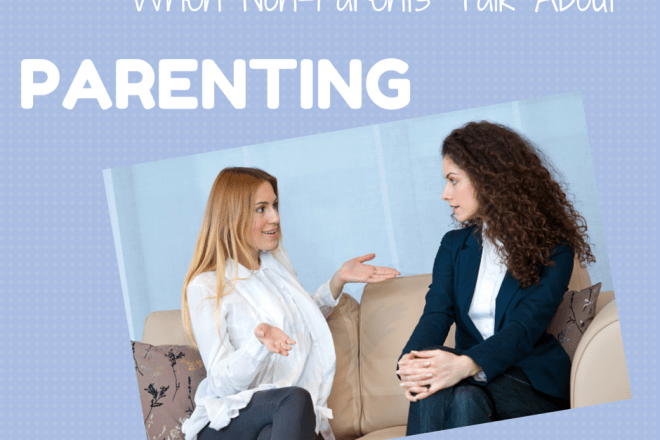
When Non-Parents Talk About Parenting

When Non-Parents Talk About

A Facebook friend of mine recently posted about how, as a non-parent, her opinions on anything related to parenting or children are discounted by friends who are parents… when she disagrees with them. She got a fair number of comments on this post, and expanded her original thoughts, noting:

“I’m rapidly becoming the only person I know without kids and being told my opinion doesn’t count at all is weird to me, so it occurred to me that unless my opinion is still pointless when I’m agreeing with parents, they’re actually only saying “as long as your opinion is different than mine, you don’t get to have one” which seems a lot more child like than parent like to me.”

I see where she’s coming from. Countless parents did this to me before I had kids, and it’s been one of my goals since becoming a mom to not do this to other people. (If I’ve done this to any of my non-parent friends who are reading this, please accept my apology!)

But I also see why parents do it. So often, non-parents speak their opinions in a way that comes across as though they would do things so much better if they were in your shoes, with such confidence in their conclusions. (I know this because I was guilty of it for sure: my kids would never behave poorly in public. You just teach them not to, right?) And any parent knows when they sense this attitude that the person talking to them is being completely ridiculous.

parents


But even if non-parents express conflicting opinions to yours in the most diplomatic way, it can be hard not to want to dismiss them. Continue reading

A Surprising Remedy for Tiredness: Host a Playdate

I woke up this morning already drained, and just knew it was going to be one of those tired days. I hadn’t gotten much sleep, woke up at 5:45 to feed the newborn, and felt a real dilemma once that was done over whether to lay back down for 15 more minutes or have a shower while my partner was still home and could look after the boys (I chose the latter). I was preemptively cranky about how exhausting the day ahead was going to be. I also had a playdate planned for later in the morning; a couple of friends of mine and their kids were going to come over.

I contemplated cancelling, apologizing but saying I just needed to ‘lay low’ and get through the day. I knew they would understand. But I didn’t really want to do that, because I haven’t had that many daytime adult interactions since my son was born a month ago, and frankly, I was craving some company and conversation. Continue reading

Bonding – a Whole Approach to Life

I recently read this beautiful essay on how human connection – not sobriety – is the remedy for addiction. I highly recommend reading the whole thing, but if you aren’t going to, I’ll try to snapshot the key points that have sparked my thinking here:

The author, Johann Hari, explains two separate addiction experiments done with rats, the long and short of which is that the rats who were kept in isolated, un-stimulating environments were exceptionally prone to drug addiction, but those who lived in ‘Rat Park,’ a healthy, happy environment for rats, were not. Moreover, once rats who had been conditioned to addiction in the isolated cages were allowed to live in Rat Park (“a lush cage” with “colored balls and the best rat-food and tunnels to scamper down and plenty of friends”), they quickly returned to a life free of drug use. He goes on to make comparisons to human examples of Vietnam-war veterans and those prescribed heavily-addictive drugs in hospital settings, which are quite interesting.

But my thought-train here has really nothing to do with addiction per se, or with rats, or with the ethics of animal experimentation. Rather, one of Hari’s passages struck me particularly:

“Human beings are bonding animals. We need to connect and love. […] But we have created an environment and a culture that cut us off from connection, or offer only the parody of it offered by the Internet.”

His argument is about addiction as a clinical condition, but I think his assessment of human beings is something we can all reflect on and learn from.

While not in as dire circumstances as many people, there are many of us living what appear on the surface, or from the outside, to be ‘full’ and ‘happy’ lives… or at least what ‘should’ be so. In truth, many of us live in self-constructed cages of isolation. Even if we’re not facing depression or constant physical isolation, we’re often more isolated than we would like to be. Why is that, especially if we are lucky enough to in fact have the means, the people nearby, and the opportunities, to be more connected, more bonded with our village?

Too often it seems we feel we don’t have the time to connect with our people, our friends and family; this is the most common cause I hear. But what are we doing instead? The usual culprits seem to be working, getting chores done, driving around to do errands, with the awful end result that when one does have some ‘free’ time, it needs to be ‘me’ time (read: a chance to collapse from exhaustion, to sleep or zombify in front of a screen).

But I think in these cases we need to question the importance of the things we’re using our time for instead of connecting – because at the end of the day, we are choosing to do so, and only by acknowledging our own agency can we start to either change it or become okay with it.

Do our living spaces really need to be tidy in order to enjoy our home with those we love? Does our time need to be ‘free’ of obligations or to-do lists before we can engage with our people? Or would it be better if we did more things communally – buying food, cooking, folding laundry – embracing that we’re all going through this together, rather than feeling we need to ‘get our shit together’ before we can enjoy one another’s company? Do we really need to ‘unwind’ at the end of a long day by scrolling through a social media feed that only gives us that ‘parody’ of bonding? We could instead be actually connecting with the people and activities that bring us joy, or indulging in that ‘me’ time by having a bath, walking outside, or doing an activity that engages our bodies and minds rather than just collapsing from exhaustion, often in front of a screen?

We have created a culture, as Hari says, “that cuts us off from connection.” The expectation is that we will all live in our own little kingdoms, whatever your particular box of living space looks like, and that our first responsibility is to keep our own kingdom in order. If we are good at keeping this order – bringing in the right amount of money for our lifestyle, tidying and cleaning, having the ‘right’ groceries in our cupboards with our near-future meal plans settled, having at least some plans in the works for how we’ll change our kingdom/life, and maintaining whatever image we’ve created of our lives in our online worlds – then we can occasionally, when it’s a ‘good’ time, invite others into our kingdom to enjoy the space we’ve cultivated, or allow ourselves some time away from our boxes to enjoy someone else’s kingdom… provided they have kept their kingdom in order, of course.

Perhaps we need to start living with each other, instead of alongside one other with the occasional meeting in the same space.

The people we wish we bonded more with might live in the same space as us, our spouses or children; they may live down the street or across town or across the country or the world, and technology may be a necessary tool for allowing us to simulate face-to-face interactions with some of them. We may wish to bond more with ourselves, to connect with our interests, and hobbies, those experiences that allow us to feel more alive, more engaged and joyful.

The point is not how we connect but whether the connection, the bonding, is a real bond or a parody. Even more so, the point is accepting our own agency (should we be so fortunate as to have some, as there are many in the world who truly don’t), so that when we feel we’re living in a cage, we can look around and determine honestly if the bars are real, or if we’ve given them form and weight with our own perceptions.

“Bonding” in this broader sense doesn’t seem to be something that can be done or felt effectively if only allotted in rare, discrete blocks of time; such a model means there will also be set times of isolation, boredom, or loneliness. It would be idealistic to think all of life will be continuous bonding and connection, but it also seems sad and unnecessary to resign ourselves to a life plan where bonding and connection are rare ‘treats’ if we’ve been ‘good.’ I’m not sure what the solution is, but I think it’s worth some serious consideration, and I hope some of you will leave your thoughtful comments below!

Letter to My Postpartum Self

If you’ve read this blog before, you might have come across my account of the dark, twisty postpartum period I had the first time around that caused my current, second pregnancy to, well, basically scare the shit out of me. Fortunately, I’ve had time to reflect, talk this fear out, and hear some wise words from other mamas in my village. Still, I know it’s easier to keep hold of these calming thoughts while Mister Baby is still in my belly than it might be once he’s out here in the world and my postpartum hormones mix with sleep deprivation in a toxic brew of negativity. So this letter is not only for me, to come back and hold onto in any twisty moments I might find in the year ahead, but also for any mamas out there who are in the dark place now, or who are pregnant and worried about moving into the dark once their baby arrives. Much love to you.

Dear Mama,

I know things are difficult right now. That things may seem like they’re falling apart, or that all your preparation has been for nought, or that you don’t even recognize who you are anymore, or maybe even all three at the same time. You may be questioning core things about yourself, your abilities, your judgment, your life, your partner, and not believing there could ever be a time where this uncertainty ends. All I can tell you is that even though you can see no light at the end of the tunnel, there is a lightI promise. I’ve been down this road before, and so have mamas since time immemorial. But I know that right now this seems like cheap platitude, so here are some thoughts for while you wait for that little light to appear and grow larger:

Hormones

They are rampaging right now, and are extraordinarily powerful, so don’t discount them. Remember those horrible adolescent years where you didn’t know what to do, or who you were, or how you were ever going to get to where you wanted to be? Same thing in early motherhood. This is hormones mixed with being thrown into the deep end of new expectations and new experiences, while striving for independence and a sense of accomplishment within this new angle of what it means to be a woman. But remember those wonderful teenage years where it seemed like everything might turn out a moony fairy-tale after all, and you couldn’t wait for all the fantastic experiences that were certainly ahead of you? This is early motherhood, too. This is hormones mixed with the delight in your little one’s smiles, snuggles, and that unbelievably good baby-smell.   So it’s a roller coaster, but a roller coaster you’re riding with a blindfold on. To pretend you’re taking a train ride, or to feel as if you should have been able to predict that next rise or fall, is ridiculous. You can prepare a bit, but some days, a fall you didn’t expect will still knock the wind out of you. When this happens, you don’t need to justify why – you’re on the roller coaster, that’s why.

Feelings

Similar to hormones, these are only sometimes things you have any control over, and they come in waves. Sorting out whether this particular rage about some unfinished laundry is the result of today’s emotional tsunami or a legitimate, last-straw outburst you would have had in the pre-baby days will be difficult. So if you think something specific or tangible is causing your melancholy or exasperation, notice it, but wait until the wave passes to decide how to move forward. Never be afraid of identifying a feeling, or admitting that you don’t know where it’s coming from, or that it’s overwhelming you. This is not a failure of rational thought – this is rational thought, because you’re recognizing the reality of your situation. The incoming tide will eventually stop, and you’ll be back to the emotional levels you’re used to handling as a reasonable adult.

Your Body

After birth it will be yours again, but not yours. You will still be attached to your babe for most of the day. You will not look like your pre-pregnancy body, at least not for awhile. You will not have your libido back, perhaps not for a much longer while than you find acceptable. You will be exhausted, at first from the experience of birth and its initial recovery, and then from carrying your wee one in your arms instead of in your belly, from night-wakings and extended periods of crying (from you or your little one). This is okay. Motherhood and marriage/partnership are long games, and you have time to adjust. There is no need to freak out about where you are 6-weeks, 3-months, or 8-months down the road from the birth day, or worry that this is where you’ll be forever. It isn’t.

10553883_10102005630891900_7139848070279818814_o

Housework

Acknowledge your role as a new mother, and not, unless this is your long-term plan, a ‘stay-at-home parent’ (even if this is your plan, give yourself some time to just be a new mom first). Keeping your baby alive and yourself sane can be a full-time job in itself, with simply no room in that job description for ensuring a tidy living room, kept-up laundry, made beds, or washed dishes. Keep the division and expectations of household labour at pre-baby levels until you’ve had a chance to adjust; don’t take everything on yourself just because you’re ‘at home’ now. If you’re going back to work after a year, this adjustment could be the whole damn year. That’s okay. If it takes less than a year, bonus for you, but treat it as a bonus, not an expectation.

Family

Fuck the advice you’ve received about ‘managing’ family interactions in the postpartum period – you’ve probably been told to both accept all help that is offered, but also to guard time to bond with your wee one so you’re not overrun with well-meaning visitors. This conflicting advice, especially while riding the hormonal roller coaster, might have you torn in the same day between desperately needing someone to be there to hold your baby so you can have a shower, but feeling like a failure if you ask for help because you can’t even manage to get a shower without assistance. Or feeling incredibly lonely for another grown up to talk to but also so drained you don’t have the energy to contribute to an adult conversation. In those moments, identify your feelings – loneliness, or irritability, or  perhaps a desire to just be alone with your baby but only-after-that-shower-because-unless-that-happens-you’re-going-to-go-crazy. Look at the feeling for a minute, then let it drop beside you onto the floor. And then ask for that help from someone who loves you, and be honest with them about that feeling so they can help you in the way you need, which is really what they want to do. Trust me.

Bonding with Your Wee One

You are your baby’s only mama, and no one can replace you. Even if/when you don’t breastfeed, even if you go back to work early, even if your wee one loves spending time with other relatives and friends… none of these things change that you are momSo embrace those other relationships for your child, embrace the good things that come along with the absence/end of breastfeeding (inebriants, non-nursing clothes, and outings longer than 2 hours, anyone?), and embrace the return to the parts of your professional work that you enjoy. Cut yourself some major slack on the bad days (see all the thoughts above), and luxuriate on the good days, so that you live presently in the moment with this new tiny person who is constantly learning more about the world, and about you, his mama. Love every new discovery. Teach him to breathe deeply through pain even when you think you might fall apart instead. And remember that this moment in time, whether it’s going fantastically or horrendously, will end. Let that knowledge increase your appreciation of the moment or your comfort for the future – or perhaps both, if it’s that kind of day.

10712701_10102104677381940_8734868266176525875_n

Remember that you are working through a tremendous feat, walking on the rocky mountain that is the postpartum period. There is no finish line, no set path, no goal to get to the top, even though it may feel like you should have such a goal in sight. There is only your experience of each day on the mountain, how you feel there, and the memories you will keep later. Eventually you will leave this mountain, but you may not even notice when the ground evens out. So don’t worry about looking for the plateaus – just live in the place you are today, find a spring of fresh water and a soft place to lay yours and your baby’s head. Whenever the sun is out, take a pause to let it warm your face. If you do that each day, you’ll be just fine.

Love,

Lindsay

What to Expect When You’re Expecting… Again

Finding out you’re pregnant with your second child is different than the first time around. At least, it was for me – and not the way I expected it to be (surprise, surprise, like everything else about motherhood). I’d seen things like this Coke commercial and thought Good News Round 2 would be simply an ecstatic air-punch, because yes, although my partner and I were both tired beyond belief and being parents was in some ways the hardest thing we’d ever done, we’d know what we were getting into this time, and all the true wonders of a new child would overshadow any trivial worries we might have had as parenting-virgins.

Instead, I saw the little blue cross in the window, did the 2nd test in the box just to be sure, then went upstairs to where my husband was still sleeping and said, “Uh, John, it’s positive.” I was stunned. I’m not even sure if I was happy at that moment. I was instantly overwhelmed, and I wasn’t sure exactly why. Sure, Arlo was only just a year old, and it was earlier than we were planning to have our second. But we already have all the needed stuff for a baby – the toys, the furniture, the gear, the clothes. We’ve experienced recurring thrush infections, sleepless nights, sleep training, traveling with an infant, introducing food, and teething. We have family nearby who are always ready to help out and a fantastic support system of friends. I thought I should feel ready to tackle this next phase of life – after all, we were going to get the ‘baby years’ and all their ensuing difficulties out of the way much faster than anticipated, which should be a good thing, right?

After several hours, I felt some moments of happiness about my pregnancy – I did, of course, remember all the bliss that went along with having a newborn, after all – but I still had this underlying, nagging worry. I couldn’t pin it down to any one specific thing: I thought about how to get two kids to share a room, how and when to wean Arlo off breastfeeding before needing to nurse another tiny person, and how we’d ever get some rest if our kids just took turns not sleeping through the night. For every one of these worries, though, I knew we’d find solutions, and if we didn’t, the worst would only be temporary. So what was this overarching anxiety I felt?

The reason I couldn’t identify my fear is because I assumed it had something to do with the babies. Really, what I was afraid of was myself. There were some dark days – some very dark and twisty days – when Arlo was in the 4-6 month window. I remember feeling helpless, out of control, and like I could no longer see the adult person it took years to become but whom I love very much and of whom I’m quite protective.  Instead, I saw a sleep-deprived, crazed, insecure ghost of a woman, who cried without explanation and lost her temper at the drop of a soother, who was unpredictable and went from loving life to wondering why everything was so fucking horrible in two seconds flat, who was unreasonable and couldn’t seem to rise above the chaos to just love her sweet, entirely perfect little baby. Those moments were, undoubtedly, the worst I’ve ever felt about myself, which is saying a lot, considering the self-esteem issues and anxiety I faced in adolescence.

I haven’t been worried about the logistics, the day-in-and-day-out details. I haven’t been worried about how John and I will cope, because we can get through anything. I’ve been worried about myself.  Nervous that having gone through this once won’t stop me from having a meltdown when I’ve almost got baby #2 asleep and the cat pushes open the creaky bedroom door, ruining my efforts. Afraid that when this new little one demands so much of my attention, I’ll have less patience for my sweet son, who will still be really, just a baby, but in comparison will seem like such a big boy that I’ll expect too much of him. Terrified I won’t have learned anything from the first go-round of motherhood and that, all over again, I’ll drag so many could-have-been-lovely days and moments through the mud with my hormones and emotional baggage.

This particular wave of nerves and fear has, thankfully, passed. I’m now over the morning sickness and unbearable fatigue of the first trimester (which helps everything seem more manageable), and as I’ve talked with more people about the second foray into motherhood, I’m starting to really believe that just as this new little one won’t be the same baby as my first, I won’t be the exact same mother I was my first time through. I will have learned some things, and I’ll hopefully be able to maintain some perspective and grace even through the tough moments with baby #2.  Will I have some dark and twisty moments? Probably. Is that still terrifying? A little bit. But being honest about my fears, even if they’re difficult to admit, has been a big first step in making them a whole lot less scary.

What about you, Mamas? Anyone scared about the next time around? Anyone had an unexpected reaction to a pregnancy? Tell us your story in the comments, or, if you have more to share, let me know – we’d welcome your guest post here at Raise a Mother!

When Returning to Work Doesn’t Break Your Heart

I had to go back to work early after the birth of my son, by the standards of most people in my life. Not early compared to my yoga-teacher friend who had six weeks off, or my friend whose mat leave living overseas was only two months, but I went back at six months, which is early to many. Having talked with other moms, I know I was in a great position to return to work – I got to start back at only three-and-a-half days a week, and our parents were willing to do the needed child care until my husband could get pat leave (I know – lucky!) when I started full-time hours.

But in the weeks leading up to my return date, I was a wreck: I was jealous of my mom-and-baby-group friends, looking ahead to a time when they would continue to have play dates with their babes while I sat at a desk wondering what my kid was doing all day (turns out he was still at mom-and-baby group, just with Dad). I was embarrassed about handing my son off for care without a regular nap schedule, as if that would somehow signal incompetence in that I’d had him for six months and still didn’t know what I was doing. I was anxious that my absence would somehow weaken our bond – or, as my sister put it, I “kind of did” want him to stay a bit of a mama’s boy even though I knew meaningful relationships with other caregivers were important and good, and would make my life a hell of a lot easier in the long run.

The moms in my village gave me great support, encouraging me that John could help with the household duties more so I could spend more time with Arlo when I was home, assuring me that all mothers felt this way when they went back to work, and even telling me it was okay if I just cried all day in the bathroom for the first day back.

So imagine my shock when I had (dare I say it?) a wonderful day. Everyone asking about the baby and wanting to see pictures, getting to see friends I hadn’t seen much since Arlo’s birth, wearing grown-up clothes with no chance of food smears or drool? Of course I had a great first day.

But then the guilt-inducing thing was, I kept having great days. I like my job. I like my colleagues. I like walks at lunch by the river behind my building, bike rides with friends to work in the morning, and drinking a whole cup of tea while it’s still hot. Best of all, every day when I came home, Arlo was limbs-flailing, goo-goo-ga-ga ecstatic to see me (a reaction that had largely been reserved for working-Daddy or post-babysitter greetings until that point).

This is where assumptions about motherhood paint us all into corners. Here I was, with all the support in the world (online and in-person) to get me through a shit time, but I was actually having an okay time, and the fact that I wasn’t falling apart made me question a) whether I was a good mother, and b) whether I would still have the support of the mama-world or be marked as a deviant of the tribe. I haven’t really tested this theory in the online world (and I’m a little scared of the reaction I could get here, to be honest).  Among my friends and family, though, I was relieved to find that my unusual (or perhaps just less-oft-voiced) experience of being, in some ways, liberated by a return to work, hasn’t reduced the support I’ve felt at all.

We’re all going to have awful times as mamas – hair-tearing, heart-draining, insanity-inducing moments. But we’re also going to have hurdles that end up not being as bad as we thought they might be. For some of us, going back to work is in column A, and for others, in column B. Where we end up probably depends on a wide range of factors. But wherever you fall when you go back to work, it’s okay.

~ Lindsay

Who We Are

DSC_0031

SHANNON SOMMERAUER DOUMA

I want this space because becoming a Mom expanded who I am and didn’t narrow it, because I struggle with trying to be Superwoman and  I’m not always very good at embracing help when it’s offered, and because I have always loved taking creative adventures with my little sister. I live in Ottawa, Ontario with my lovely husband Randy, our beautiful son Lucas, and feline buddies Sully and Maybee. I spend my working hours at the Canadian Parliament and my playing hours with my family, friends, and an ever-growing list of books to read, wines to try, and things to knit.


11537717_10102554839558330_79785188995071007_nLINDSAY SOMMERAUER

I want this space because I’m in favour of honesty over image and compassion over judgment. I want a place for thoughtful ideas whose speakers keep their minds open to the ideas of others. I want a space free of the judgment, competition, and glossy-falseness that are rampant in the online world of mommy-blogs. A place where we can celebrate our strengths, laugh through the little trials, and find comfort through the big ones. Where it’s okay to admit that you sometimes just want a break from your kid while other times you want to do nothing but be with them forever, and neither option makes you a bad or good mother. A space where we as women (who happen to be mothers) can offer each other support and solidarity, giving each other the benefit of the doubt that we’re all doing our best, and learning from our shared and different experiences.

I’m the mama of sweet little Arlo, partner to the wonderful John, and human companion to felines Kicsi and Koschka. I work at a university helping undergraduate students overcome their hurdles, teach dance fitness for my own creative and energy outlet, and wish I made time in my life for more yoga.