One Birth Story

There are two reasons for sharing my birth story in this particular way.

First, online discussions about birth are too often fraught with tension, either focused on quantitative details (length in hours, degrees of tearing, number of interventions, etc.) that can be used to compare/measure us against fellow moms; or devolving into endless debates with battle lines drawn on natural/medicated or vaginal/c-section grounds. Ultimately, though, we are all women who have experienced something at once unbelievably common and, at the same time, incredible: the growth of tiny people inside our bodies who are now real live people in the outside world. So I think we also need space for us to just share how that experience felt for each of us, without comparison or needing to identify our position on some ‘debate’ about motherhood.

Second, my central Scary Unknown the first time around was what labour would actually feel like, and I didn’t feel my childbirth ed class really covered it. Particularly, what might it feel like when the baby actually comes out, the precise moment when something that was the size of a beach ball under my shirt would actually exit my body? A reasonably terrifying prospect, but oddly, a memory which faded within a few months of the experience. I remembered all the quantitative and factual details that get retold endlessly to family, friends, and new fellow parent acquaintances, but I didn’t remember what the contractions or pushing actually felt like. Growing and delivering a child is the most awesome physical feat I have ever accomplished, and I imagine I’m not alone in this sentiment. It seemed a shame that I didn’t have any qualitative memories of what my body actually experienced.

(Heads up: The author knows she has a few friends who are uneasy with a lot of vag-talk, so if this is you and you don’t want to read descriptions of her reproductive parts, maybe skip this one.)
Pregnant mother

How is this supposed to go again?

So with these two things in mind and my second delivery approaching, I decided to journal about my experience of childbirth – during my labour:  Continue reading

#goodenough – Because It REALLY Is

I think most parents of young toddlers know the frustration and chaos that is their kid’s toys. They get everywhere, they’re disorganized, and you don’t have time as every new toy is brought into the mix to go back through and carefully choose all of those no longer developmentally-appropriate for redistribution to the Goodwill. So what you may end up with is a giant crap heap of some stuff that your kid is really into, but a lot of things they have zero interest in. Either way, they can’t really find things because it’s all a crap heap that just keeps growing.

And if you Google things like, “how to organize your kids toys,” you’re greeted with beautiful, Pinterest-worthy ideas that will not only have your kid’s toys sensibly organized, but also in lovely containers that match your home decor!

Well, you can probably guess where all those images remained in my life – in the online desert-mirages from whence they came. Continue reading

A Surprising Remedy for Tiredness: Host a Playdate

I woke up this morning already drained, and just knew it was going to be one of those tired days. I hadn’t gotten much sleep, woke up at 5:45 to feed the newborn, and felt a real dilemma once that was done over whether to lay back down for 15 more minutes or have a shower while my partner was still home and could look after the boys (I chose the latter). I was preemptively cranky about how exhausting the day ahead was going to be. I also had a playdate planned for later in the morning; a couple of friends of mine and their kids were going to come over.

I contemplated cancelling, apologizing but saying I just needed to ‘lay low’ and get through the day. I knew they would understand. But I didn’t really want to do that, because I haven’t had that many daytime adult interactions since my son was born a month ago, and frankly, I was craving some company and conversation. Continue reading

Sure, the ‘MEternity’ Leave Idea Seems Idiotic… But I Can’t Really Blame its Author

Meghann Foye has been getting a lot of attention for her NY Post piece about wanting her own ‘maternity’ leave without having any kids… called a “MEternity leave.” Granted, this is probably just a publicity grab for her new book, which I have no opinion on as I haven’t read it, but this piece alone is getting quite the reaction from parents, who are largely outraged at her insinuations that parental leave is an opportunity to obtain lifestyle flexibility, time for self-reflection, and a renewed sense of self-confidence if you’re burnt out at your workplace.

“Ha. HA. HAH!,” yelled, in unison, all parents who read this ignorant, unicorn pipe dream.

There have been some hilarious and cathartic responses written to Foye’s piece, like this one at Scary Mommy and this one over at Yackler Magazine. Both of these take Foye’s proposed ideas down with wit and acuity. Read them!

I can’t, though, in all honesty, attack Foye myself. Because deep down, I know I was not devoid of similar thoughts about maternity leave… BEFORE I had kids. And I know I’m not the only one who had wildly inaccurate, ridiculous, idiotic notions about what maternity leave would afford me as a new parent: Continue reading

When I was Disappointed by My Child’s “Gender”

With my first pregnancy, I really wanted the sex to be a surprise – after all, it’s the one major surprise in life you know is going to be wonderful either way, right? I got a thrill imagining all the possibilities of who my little unborn person could be, without gendered boundaries. I was thrilled when my son was born – I saw him on the bed below me and immediately squealed, “Oh my god, he’s here!” I tried to pick him up so fast the midwives had to stop me so I wouldn’t yank the cord.

My second pregnancy was an entirely different story. As you may know from a few of my other posts, I’m a feminist. I believe strongly in deconstructing the patriarchal values that disadvantage people who aren’t heterosexual, cisgender males in our society. So perhaps it won’t surprise to say I always hoped I’d have a daughter. I envisioned a young woman who I could raise to be a strong bulwark against the bullshit of the patriarchy, someone who would resist gender stereotypes and prove “the man” wrong with her intelligence and independence. My husband hoped for the same. We only plan on having two kids, so suddenly the sex of this little person had more at stake, and we decided to find out at the 20-week ultrasound. We’d heard enough stories of people who’d been disappointed with a baby’s sex, so finding out in advance seemed like the safer option.

When the ultrasound technician pronounced the fetus male, Continue reading

Gratitude Journal #2: A Heart Full of Love

A HEART FULLOver the past few weeks, our house has been suffering from a cold that just seems to be bouncing back and forth between the members of our household. This week, our 22-month old son was the main victim. The result was an increase in toddler meltdowns and a pronounced decrease in the quality and quantity of sleep for all of us.

Needless to say, this has not been an easy time. But somehow – just at the very moments when things get tough – I’ve found reminders of all of the love and support in my life.

When I got to work bleary-eyed from a night of broken sleep, and a chat with some co-worker Moms reminded me that none of us are alone…

When I totally dropped the ball on something my sister had asked me to do weeks ago, and she reminded me to be a little kinder to myself…

When my husband and I fell into bed completely exhausted, and our kindness with each other reminded me how important he is to me…

When I just wanted to go back to bed in the middle of the night, and my son snuggled into me, reminding me how much he needs me…

In all of these moments, I’ve felt my heart bubbling with love and gratitude. Sometimes, it’s hard to see the forest through the trees. This week, I’ve been fortunate to be able to peek through the challenges of this time, and glimpse the loveliness of my life.


The Thing I Sometimes Forget About Professional Advice

This past week, I struggled with feeding my son. He didn’t gain as much weight as they would have liked, so I was advised by the midwife who came to visit me that I needed to feed him every 2 hours.

I did so for two days, and described to another midwife who came next to re-weigh him how a 2-hours system allowed him very little sleep, since he took a long time to feed, and then didn’t have much time to sleep before I had to wake him up again and try to force him to eat once more. (Before I started forcing a feed every two hours, he was sleeping four-hour stretches each night, so I’ll admit, it also just felt in violation of every instinct to wake a sleeping baby in the middle of the night when I’d been handed such good fortune!) She said I could feed every 3 hours instead, and maybe allow a 4-hour stretch once per night.

Two days later, this seemed to be just as bad a situation as every 2 hours, and I called the midwife paging service, hoping for some additional advice since I felt stressed out. It felt like our day was just an endless cycle of me forcing him awake, trying to force him to eat even though my breasts didn’t feel full yet, him sleepily not eating a whole lot, him being more awake in between attempts to latch him but then mostly just falling back asleep on the boob every time we returned to it. Then we’d start the whole cycle again after about 40 minutes of sleep. I had no idea what my kid’s natural rhythm was so I wasn’t even sure where to start on getting us into something that felt better.

Midwife #3 listened, then had a completely different response: “Stop waking him up,” she said. She explained why, based on everything I’d told her about our experience and my son’s health thus far, it would be okay to try for a few days going with his schedule, letting him decide when he would eat. If that worked and he still gained weight at the next re-weigh, then we had our answer. If he didn’t gain as much as they’d like, then we’d address it then, and that would be fine, too, since the next visit was only two days away.

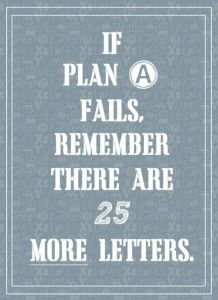
If Plan A doesn't work

When seeking expert advice, I’ve always personally felt going to a professional seemed the safest bet – after all, the profession would have equal training across its population and a set of ‘best practices,’ wouldn’t it? The thing I seem to forget sometimes is that professionals are, in fact, a group of individuals like any other group – which means each individual brings their own experiences, preferences, and beliefs to the table in the context of their professional training.

Oddly, I seem to continually forget this each time I seek professional advice, despite the fact that with everyone ranging from physiotherapists, doctors, midwives, teachers, and mortgage brokers, I’ve had personal experiences where one professional will confidently tell me is what needs to happen, only to have the next professional tell me to forget everything I’ve heard about x, because is what needs to happen. Yet when I first hear x, I obediently latch onto the instructions and follow them as closely as I can. Then when I hear y, I get stressed about why I’ve been doing x so far instead.

But this isn’t a flaw in the professionals, or a suggestion that they don’t know what they’re talking about, or an implication that some are right and some are wrong. It’s a reflection that when seeking advice, I really have to take everyone’s with a grain of salt – even from a professional – and allow that one person’s advice is based on a specific combination of training, case experience, personal values and individual conclusions they’ve reached as a result of all those things combined.

I also have to remember that any piece of advice isn’t guaranteed to work, even if it comes from a professional, because my kid (and me) are also individuals bringing other factors into the equation. It would be more comforting to have consistent advice from all professionals in the same field, to not have such things as ‘second opinions.’ But if the problems we brought to professionals were that simple, we wouldn’t need professionals at all – there would just be one standard instruction book for Renovate Your Kitchen or DIY Therapy or Raise Your Child and one size would fit all.

Remi sleeping

Turns out the third time was a charm for me and my kiddo. Following the final midwife’s advice did the trick – and after a day and a half of longer sleeps, my wee one started gravitating to 3 hours between feeds all on his own. I guess he just needed to reset and catch up on some of the sleep he hadn’t been getting first.

And, luckily, he still usually gives me one 4-hour stretch between nighttime feeds (phew!).

Overcoming “Be Careful”-itis

Roald Dahl quoteThis past week, I was listening to a recent episode of One Bad Mother. The conversation was about struggling with reflexively saying ‘no’ to your kids – even when you don’t really have a problem with what they want to do.

My son is young enough that I’m not yet struggling with being a ‘no’ machine, but I do find myself reflexively saying something else. My personal catch phrase? “Be careful”.

I cannot seem to stop myself from saying “be careful”. “Be careful with the cat”. “Be careful climbing on the couch”. “Be careful on the stairs”. “Be careful”. “Be careful”. “Be careful”. All. Day. Long.

Obviously, some of this is justified. My son is not yet two. We still have a baby gate for our larger staircase. He starts to lose his balance and run into things when he’s tired. He is definitely not at stage where he doesn’t need any reminders to be careful.

At the same time, my son is already a fairly cautious child, as toddlers go. He is not particularly anxious. He gets a kick out of being a little bit scared, like when his dad jumps out at him from behind a corner. But he is thoughtful and deliberate, and you can see him thinking through how to tackle a new feat before he actually tries to tackle it. When he was a baby, he routinely practiced new motor skills in the safety of his crib before he would dare to try them anywhere else.

I, on the other hand, was an overly cautious child. My mom had to convince me to let go of her hand in the grocery store when she needed both of her hands to lift something (or to stop my sister from running off). I was scared of climbing and hated hanging upside down. And while I would not consider myself an anxious adult, I do still fall into the camp of: “I’m cold, so you need to put on a sweater”.

It’s definitely not my favourite part of myself. Even as a kid, I wished that I could find a way to just let go a bit. Now as a parent, when I hear myself say “be careful” for the seven-hundredth time that day, I can’t help but wonder if my worrying tendencies are at risk of stifling my son’s independence.

I feel like Marlin in the movie, “Finding Nemo”, the parent whose over-cautiousness is holding back both his child and their relationship. He tells his friend Dory, “I promised I’d never let anything happen to him”. Dory responds, “Hmm. That’s a funny thing to promise. You can’t never let anything happen to him. Then nothing would ever happen to him. Not much fun for little Harpo.”

Not much fun, and not a great way to learn, either. Roald Dahl once said “The more risks you allow a child to take, the better they learn to take care of themselves”. This makes a lot of sense to me. After all, who among us doesn’t credit our biggest risks and/or failures with our best learning experiences? Either we rise to the challenge and boost our self-esteem in the process, or we find out what doesn’t work and try to do better next time.

And this is really what I’m talking about when I’m thinking about ways to get over my “be careful”-itis. I’m not going to avoid saying “be careful” when my son could really hurt himself or when he can’t reasonably be expected to understand the potential consequences of his actions. But I do want to try to avoid reflexively saying “be careful” in circumstances that he can navigate on his own.

Maybe it’s ok for him to learn that if he’s not paying attention to what he’s doing, and a board book lands on his foot, he probably won’t like it. And he’ll learn to take better care of himself the next time he’s at his bookshelf. I mean, how else does a little bird learn to fly than to start by falling? It’s not like mama bird kicks them out of the nest right from day one. She watches and waits until they’re ready. After that, there’s really no other way to do it.

Even typing this makes me feel a bit guilty and gets the worry machine going in my head, so I know it’s probably something I need to work on. In the meantime, I’m just going to try to channel my inner Dory and just keep swimming.

Baby Bird Try To Fly

A Little Re-Frame Changes the Whole Picture

Sometimes we get stuck in ruts that suck. There is a certain situation or environment that is constant or recurring in our lives, and it sucks… worse, sometimes, we know we suck in it. Those circumstances that bring out the worst version of ourselves, but we can’t avoid them because they are necessary to our lives. They could be at work, at home, with relatives, with friends, or with our kids. My own awful circumstance that I’ve been re-thrust into this week is the Dreaded Newborn Night Wakings. My son was born one week ago (hurray! I’m finally done being pregnant!), and nighttime feedings are once again part of my routine (ahhh! I’m a terrible person when I’m tired!!).

Night wakings with a baby are the circumstance that brings out the worst in me. So re-entering this space (my older kid has been sleeping through the night consistently for several months now and it’s been blissful) suddenly sparked an all-too-familiar, trigger-happy, irritable anxiety that only manifests between midnight and 5am. In this space, an uncooperative support pillow lights a match of rage in my throat, and a refusal by my days-old child to immediately go back to sleep after a feed ignites the urge to throw a toddler-esque tantrum and whisper, “Fine! We’ll just sit up all fucking night then!” Like I said, I’m a terrible person when I’m tired. I long ago accepted this about myself, and always try to get enough sleep to avoid the monster coming out. This tried-and-true strategy of consistent bedtimes and eight hours of sleep is just not an option for the near future, unfortunately.

I’m sure (or at least I hope, even just so I can feel less terrible about it) that most of us have these situations – certain circumstances that get under our skin and change our reactions and behaviour for the worse. Yesterday, however, I decided to try to do something about it, and I was amazed at how calm and peaceful last night was as a result! So I’m feeling pretty great about it today and thought I’d share.

The first thing I did was re-frame the purpose of the situation. Instead of thinking about The Impending Horrible (night wakings) as drudgery, as simply a necessary, sacrificial duty of my life, I decided to think of them as a opportunity for long-term gain. As I imagine all parents of newborns are, I’m very invested in helping my son learn to sleep well, calmly, and most importantly, through the night. And as a second-time parent, I’ve already noticed myself being much more calm and collected during the day in moments that distress him as a newborn, than I was with my first. So if my son experiences me as calm and reassuring during the day, but as anxious and on edge during the night, he might learn that night is a time for being on high alert, for worrying about things – that nighttime, in short, is bad… which probably won’t help him feel at ease about sleeping through it. Keeping this big-picture purpose in mind helped me last night to stay calm throughout our feeding and awake time, even though I was just as tired as the nights before, and could have easily reacted in my old patterns.

The second thing I did was re-frame my expectations. I realized I had been going into each night waking hoping for the best (ie. that he would eat quickly and go right back to sleep) but focusing on and anticipating the worst (my exhaustion and the possibility that he would stay awake all night). I took a look at my baby tracker app, and noticed that his average time awake per instance at night, is around an hour to an hour and ten minutes. So my expectation that we would feed for thirty and then both be back to sleep was simply unreasonable. I was setting myself up for failure and irritation every time. Looking at the clock when he woke up last night, and expecting that I would be awake for up to an hour and fifteen minutes more, helped me to not feel anxious the whole time about when the feed would end, if he was eating fast enough, etc. And when he did go back down faster than that, it was a pleasant surprise instead. By being realistic about the crappy situation that I normally approach with wildly idealistic expectations but a sour, pessimistic attitude, the whole thing got a lot better.

I’m going to try to remember these two approaches to other situations that I find grating, irritating, or generally rut-like in my life. Because being calm and moving with what felt like a little more grace through this rut last night was not just easier on those around me (my son, but also my husband, who gets up with me at this stage to pass the baby to me, change his diapers when needed, help soothe him back to sleep, etc.). More importantly, it made me feel more in control of myself, instead of like the sleep-deprived monster I never seemed able to keep at bay before.

What about you, lovely readers? What are your ruts or your recurring, inner-monster-inducing spaces? How do you help yourself move through them as best you can?

Book Review: My 2 Favourite Parenting Books

If you read my previous post, you’ll know I have a problem with parenting books, at least the ones that present like self-help ‘manuals,’ implying that our kids are one-size-fits-all, that there is some ‘magic’ that will get your child to [insert your particular parenting struggle here], and ultimately, just making you feel bad about yourself when the ‘magic’ doesn’t work.  But as promised, I said I would write my next post about two books I have actually found very insightful and helpful in my transition to parenthood so far, instead of just ranting. Here goes.

The Books

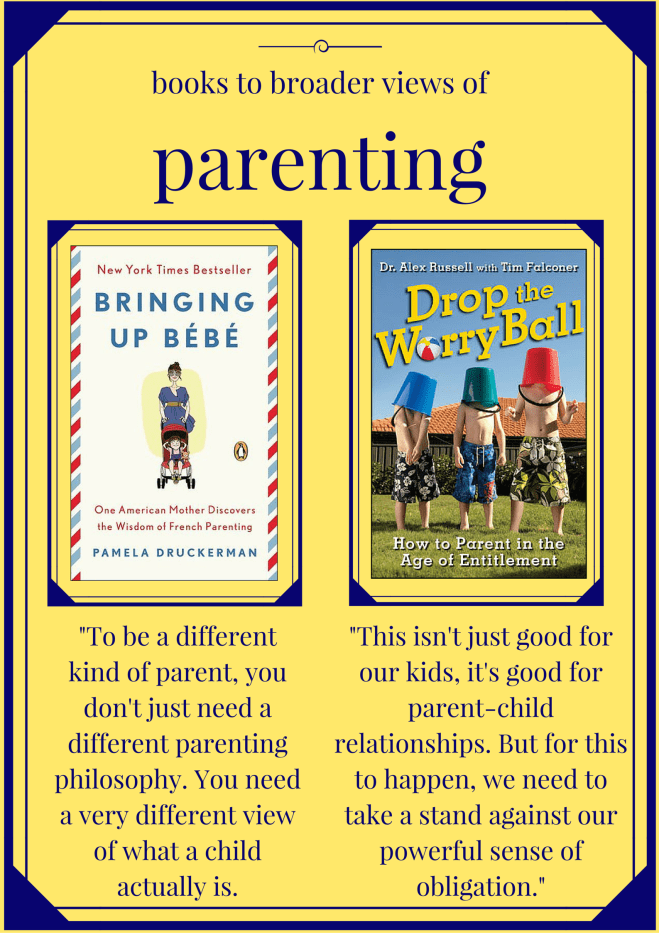
bringing-up-bebe coverI’ve mentioned book #1 a few times on this blog already: Bringing Up Bebe by Pamela Druckerman. An American journalist raising young children in Paris, Druckerman notices that “French children sleep through the night at two or three months old. They eat braised leeks. Their parents sip coffee while the kids play by themselves.” Naturally, she wonders what the French are doing differently from American parents, for whom these things are definitely not the norm, and sets herself the quest of figuring it out. I found her book engaging, funny, and fascinating from the first time I read it as a newly pregnant lady, and I find something new every time I re-read it.


9781118124949_cover.inddBook #2 is Drop the Worry Ball by Alex Russell, which delves into the muck of the contemporary North American family situation that so starkly contrasts to the French reality I read about in Bebe: sleeping troubles with much older kids, rampant picky eating, parents who can’t seem to enjoy any adult time if their kids are awake… He addresses the reality that trials like these are not only culturally accepted as inescapable facts of being parents, but worse, topped with a self-sacrificial badge of honour for accepting and slogging through them. I saw Russell speak at a conference this year, and was struck by his candour, his clarity, and the refreshing good sense he brought to the topic. I knew immediately I wanted to get his book out from the library, and am I ever glad I did!


Now, as I wrote in my last post, what I like about these books is their broader, less instructional approach to parenting. In Bebe, Druckerman doesn’t find as many easily-replicable ‘tips’ among the French experts as she hopes. When she tries to simplistically implement a phrase or action that she sees French parents use with easy success, it often doesn’t work. As she tackles each aspect of parenting, she discovers that the French don’t just do things differently, they have a whole different philosophy around parents, children, and families. In Worry Ball, even though it has a ‘how to’ subtitle, and even though Russell is a practicing psychologist who describes many case studies with tangible examples, there aren’t many instructions. He insists the “professionalization of parenting” via “parenting guides” has led to the “steady erosion of parental confidence,” and so deliberately keeps the tips to a minimum, instead hoping to help readers rethink the parenting role in a more holistic sense for themselves.
books to broader views of parenting

So Why Talk About These Books Together?

While I didn’t expect this when I started reading Worry Ball, I actually find these to be great companion books, for a couple of reasons. After all, they address the same core issues that seem to plague North American parenting these days:

  • family lives revolving entirely around children’s desires and “happiness”
  • parental couples who have little time to focus on themselves, or each other
  • troubling levels of entitlement, disrespect, and non-resilience among children
  • parents who feel they have zero control over behaviour or tantrums
  • immense cultural pressure to do parenting “right”
  • heavy feelings of guilt/responsibility for your child’s behaviour

The list could go on, but you get the idea.

What I love about reading these books together is that they tackle the same issues from different angles, giving me a more complete picture, and often, more reassurance.

Angle #1: Relatability

Druckerman brings the vantage point of a mother, an everywoman who struggles not only with her ordinary parenting interactions, but also with not understanding how we/she got here in the first place. (Why is there so much pressure, such guilt? Why is it so difficult to convince her kids that she is in charge? And why is it so hard to break out of these patterns?) She explores the work of parenting experts, but is often frustrated, as I was at first, too, with the fact that French experts, and even everyday French parents, seem to wax poetic about how to think about sleep or understand a child, when all we’re looking for is an answer to, “So what do I DO when my kid is acting up/refusing to eat/waking at night?!?!”

This is where Russell’s book comes in handy. Coming at the same issues as a long-practicing psychologist, he’s been helping parents grapple with these troubles for a long time. As such, he’s seen enough examples to sift out some answers to those “how did we get here?” and “why is it so hard to break out?” questions. He includes not only cultural/historical explanations parent-child relationships, but also many stories that highlight these theories in a more concrete way. He is also a parent, but as he mainly seems to hold an expert role in this book, it can feel easy to dismiss his ideas: “Sure, it sounds easy coming from him, but he’s an expert – that would never work with my kid.”

So Russell’s book helps to flesh out some of the “but how does that apply in my real life?” questions that Druckerman’s book might leave a little bit fuzzy, while Druckerman’s eventual successes give hope that even non-expert, regular parents can figure this stuff out.

Angle #2: Geography

Druckerman, though American, is living in France. This physical removal allows her to get outside the feeling of being ‘fated’ to follow the cultural norms and pressures so problematic to North American parenting. It’s because she’s outside this frame that I can suspend my disbelief that such transformation is possible and the reality she describes actually exists: a place where parents don’t do night wakings as a matter of course with three-year-olds, a place where kids can bake whole cakes for themselves on Saturday mornings but not freak out when they can’t eat them until 4pm. Unfortunately, this also means her successes can be easier to write off as plausible/possible only in the magical otherworld of Paris.

Russell, on the other hand, isn’t writing from the outside: he hasn’t escaped! He’s (as are his case study families) parenting deep ‘in the trenches’ of the problems at hand, yet they are able to make some positive change for themselves. He doesn’t shy away, though, from being honest with you that getting out of the traps that seem so common, or even inevitable, will be very difficult. He says doing so requires going against the flow, knowingly subjecting yourself to judgments from parents and others who don’t share your views. He validates the (perfectly reasonable) fears you might have about going against the grain as he encourages you to do it anyway.

So Russell gives us a ‘what is’ view of the trials we face as parents and admits that it’s going to be painful to get out of, while Druckerman gives us more of a ‘what could be’ big-picture view, based on what she’s seeing firsthand in France. From reading them together, I get both the realistic validation of the struggle ahead, but also the optimistic hope that a better way exists, not just for one or two people, but that it’s even possible on a more communal level.

Angle #3: Who Is This Really About?

The last helpful way that I see these books as great complements is in their focus within the family unit. Because when we start to talk about these issues, particularly under the shadow of the self-sacrificial-parenting-badge-of-honour, it can get hard to sort out why you really want to make a change. Creeping doubt questions can start to trickle into your brain: do you really think your child will benefit from sleeping later, or are you just a selfish adult who wants to sleep in? 

Druckerman seems to focus more on the benefits to parents of moving away from the North American model (or, at least, from my biased North American mind, it seems that way). While she does say it’s good for children’s development to learn that they are not “the center of the universe” and that they “can’t always have their way,” there seems to be an old-school, old-world harshness to these sentiments. We’re living in the age of “attachment” parenting, coming off the heels of the “I’m special” generation, so some values that the French seem to take for granted – that adult time is sacred, that interruptions from children are unacceptable, etc. – seem unpalatable here, and certainly not something you could claim this side of the sea without great scrutiny/judgment. Deep down, they feel so refreshing and reasonable… but you just can’t help the feeling that it’s somehow selfish to actually admit it.

Russell’s ideas focus more on the benefits to children when championing these same lessons. He goes further and insists these lessons are not only beneficial, but necessary for kids’ development. He shows convincingly how we’re actually doing our kids a huge disservice by not making a shift away from our current cultural parenting expectations and by allowing ourselves to be sucked into contemporary parenting traps.

So Druckerman appeals to and validates any underlying (seemingly selfish) reasons I might have for not wanting to succumb to obligation/entitlement/attachment parenting, while Russell rationalizes these feelings and provides confident justification for my resistance efforts.

What About You, Dear Reader?

These are just my top picks for broadening my parenting perspective… what are yours? Leave them in the comments, because we here at Raise A Mother would love to check them out!


1 6 7 8 11