If you read my previous post, you’ll know I have a problem with parenting books, at least the ones that present like self-help ‘manuals,’ implying that our kids are one-size-fits-all, that there is some ‘magic’ that will get your child to [insert your particular parenting struggle here], and ultimately, just making you feel bad about yourself when the ‘magic’ doesn’t work. But as promised, I said I would write my next post about two books I have actually found very insightful and helpful in my transition to parenthood so far, instead of just ranting. Here goes.
The Books
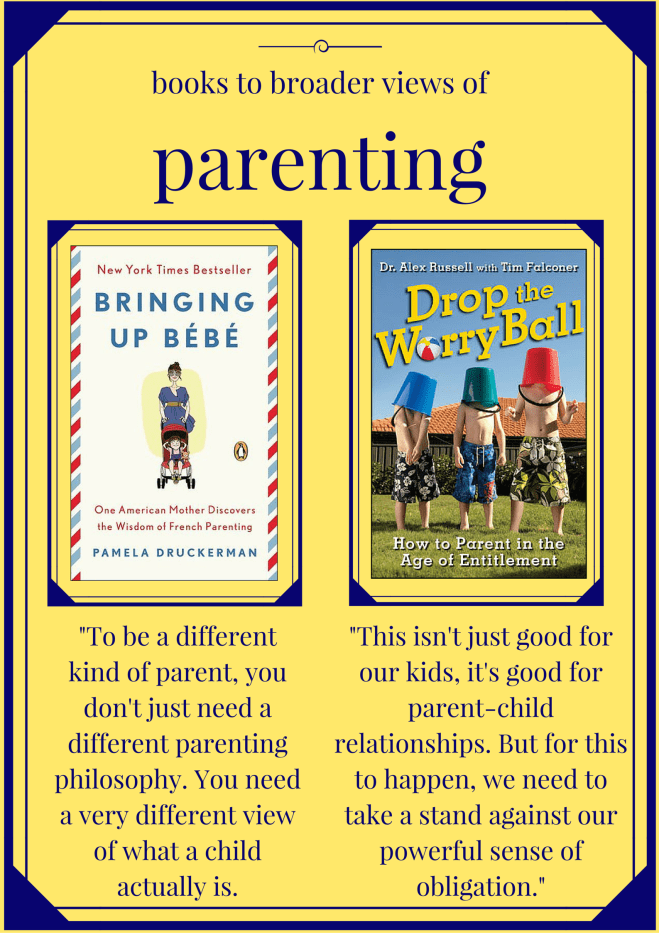
 I’ve mentioned book #1 a few times on this blog already: Bringing Up Bebe by Pamela Druckerman. An American journalist raising young children in Paris, Druckerman notices that “French children sleep through the night at two or three months old. They eat braised leeks. Their parents sip coffee while the kids play by themselves.” Naturally, she wonders what the French are doing differently from American parents, for whom these things are definitely not the norm, and sets herself the quest of figuring it out. I found her book engaging, funny, and fascinating from the first time I read it as a newly pregnant lady, and I find something new every time I re-read it.
 Book #2 is Drop the Worry Ball by Alex Russell, which delves into the muck of the contemporary North American family situation that so starkly contrasts to the French reality I read about in Bebe: sleeping troubles with much older kids, rampant picky eating, parents who can’t seem to enjoy any adult time if their kids are awake… He addresses the reality that trials like these are not only culturally accepted as inescapable facts of being parents, but worse, topped with a self-sacrificial badge of honour for accepting and slogging through them. I saw Russell speak at a conference this year, and was struck by his candour, his clarity, and the refreshing good sense he brought to the topic. I knew immediately I wanted to get his book out from the library, and am I ever glad I did!
Now, as I wrote in my last post, what I like about these books is their broader, less instructional approach to parenting. In Bebe, Druckerman doesn’t find as many easily-replicable ‘tips’ among the French experts as she hopes. When she tries to simplistically implement a phrase or action that she sees French parents use with easy success, it often doesn’t work. As she tackles each aspect of parenting, she discovers that the French don’t just do things differently, they have a whole different philosophy around parents, children, and families. In Worry Ball, even though it has a ‘how to’ subtitle, and even though Russell is a practicing psychologist who describes many case studies with tangible examples, there aren’t many instructions. He insists the “professionalization of parenting” via “parenting guides” has led to the “steady erosion of parental confidence,” and so deliberately keeps the tips to a minimum, instead hoping to help readers rethink the parenting role in a more holistic sense for themselves.
So Why Talk About These Books Together?
While I didn’t expect this when I started reading Worry Ball, I actually find these to be great companion books, for a couple of reasons. After all, they address the same core issues that seem to plague North American parenting these days:
- family lives revolving entirely around children’s desires and “happiness”
- parental couples who have little time to focus on themselves, or each other
- troubling levels of entitlement, disrespect, and non-resilience among children
- parents who feel they have zero control over behaviour or tantrums
- immense cultural pressure to do parenting “right”
- heavy feelings of guilt/responsibility for your child’s behaviour
The list could go on, but you get the idea.
What I love about reading these books together is that they tackle the same issues from different angles, giving me a more complete picture, and often, more reassurance.
Angle #1: Relatability
Druckerman brings the vantage point of a mother, an everywoman who struggles not only with her ordinary parenting interactions, but also with not understanding how we/she got here in the first place. (Why is there so much pressure, such guilt? Why is it so difficult to convince her kids that she is in charge? And why is it so hard to break out of these patterns?) She explores the work of parenting experts, but is often frustrated, as I was at first, too, with the fact that French experts, and even everyday French parents, seem to wax poetic about how to think about sleep or understand a child, when all we’re looking for is an answer to, “So what do I DO when my kid is acting up/refusing to eat/waking at night?!?!”
This is where Russell’s book comes in handy. Coming at the same issues as a long-practicing psychologist, he’s been helping parents grapple with these troubles for a long time. As such, he’s seen enough examples to sift out some answers to those “how did we get here?” and “why is it so hard to break out?” questions. He includes not only cultural/historical explanations parent-child relationships, but also many stories that highlight these theories in a more concrete way. He is also a parent, but as he mainly seems to hold an expert role in this book, it can feel easy to dismiss his ideas: “Sure, it sounds easy coming from him, but he’s an expert – that would never work with my kid.”
So Russell’s book helps to flesh out some of the “but how does that apply in my real life?” questions that Druckerman’s book might leave a little bit fuzzy, while Druckerman’s eventual successes give hope that even non-expert, regular parents can figure this stuff out.
Angle #2: Geography
Druckerman, though American, is living in France. This physical removal allows her to get outside the feeling of being ‘fated’ to follow the cultural norms and pressures so problematic to North American parenting. It’s because she’s outside this frame that I can suspend my disbelief that such transformation is possible and the reality she describes actually exists: a place where parents don’t do night wakings as a matter of course with three-year-olds, a place where kids can bake whole cakes for themselves on Saturday mornings but not freak out when they can’t eat them until 4pm. Unfortunately, this also means her successes can be easier to write off as plausible/possible only in the magical otherworld of Paris.
Russell, on the other hand, isn’t writing from the outside: he hasn’t escaped! He’s (as are his case study families) parenting deep ‘in the trenches’ of the problems at hand, yet they are able to make some positive change for themselves. He doesn’t shy away, though, from being honest with you that getting out of the traps that seem so common, or even inevitable, will be very difficult. He says doing so requires going against the flow, knowingly subjecting yourself to judgments from parents and others who don’t share your views. He validates the (perfectly reasonable) fears you might have about going against the grain as he encourages you to do it anyway.
So Russell gives us a ‘what is’ view of the trials we face as parents and admits that it’s going to be painful to get out of, while Druckerman gives us more of a ‘what could be’ big-picture view, based on what she’s seeing firsthand in France. From reading them together, I get both the realistic validation of the struggle ahead, but also the optimistic hope that a better way exists, not just for one or two people, but that it’s even possible on a more communal level.
Angle #3: Who Is This Really About?
The last helpful way that I see these books as great complements is in their focus within the family unit. Because when we start to talk about these issues, particularly under the shadow of the self-sacrificial-parenting-badge-of-honour, it can get hard to sort out why you really want to make a change. Creeping doubt questions can start to trickle into your brain: do you really think your child will benefit from sleeping later, or are you just a selfish adult who wants to sleep in?
Druckerman seems to focus more on the benefits to parents of moving away from the North American model (or, at least, from my biased North American mind, it seems that way). While she does say it’s good for children’s development to learn that they are not “the center of the universe” and that they “can’t always have their way,” there seems to be an old-school, old-world harshness to these sentiments. We’re living in the age of “attachment” parenting, coming off the heels of the “I’m special” generation, so some values that the French seem to take for granted – that adult time is sacred, that interruptions from children are unacceptable, etc. – seem unpalatable here, and certainly not something you could claim this side of the sea without great scrutiny/judgment. Deep down, they feel so refreshing and reasonable… but you just can’t help the feeling that it’s somehow selfish to actually admit it.
Russell’s ideas focus more on the benefits to children when championing these same lessons. He goes further and insists these lessons are not only beneficial, but necessary for kids’ development. He shows convincingly how we’re actually doing our kids a huge disservice by not making a shift away from our current cultural parenting expectations and by allowing ourselves to be sucked into contemporary parenting traps.
So Druckerman appeals to and validates any underlying (seemingly selfish) reasons I might have for not wanting to succumb to obligation/entitlement/attachment parenting, while Russell rationalizes these feelings and provides confident justification for my resistance efforts.
What About You, Dear Reader?
These are just my top picks for broadening my parenting perspective… what are yours? Leave them in the comments, because we here at Raise A Mother would love to check them out!

 Hey Mamas!




 These sentiments are important: if I worry about how other people do a pose, and focus on making my practice look like someone else’s from the outside, I run the risk of, at best, separation from the inner focus and peace I could enjoy from the practice, and at worst, really injuring myself.




 It Takes a Village to Raise a Mother