Parenting Philosophy

Two Moms, One Question: Toddler “Lessons”?

Hey, villagers! We’re starting a new monthly segment here at Raise A Mother, where Shannon and Lindsay take on the same question and each give their own view in a joint post.

It’s back-to-school season, but even for kids who aren’t in school yet, there are many opportunities to sign them up for “extra-curricular” activities. Are they worth it?

SHANNON:

I think this question comes down to your kid and your specific situation. My two-year-old son really responds well to structure and repetition (ie. he loves to do the same thing, the same way, over and over and over). He also goes a bit stir crazy if we don’t go for some sort of outing during the day on the weekends. At the same time, we don’t have a lot of friends with kids with whom we can arrange regular activities or play dates. So, for us, we’ve found that signing up for a weekly “lesson” of some kind is a good way to get us all up and out of the house, burning that toddler energy – without being dependent on good weather in a city that has very hot and humid summers and very long and cold winters.

For me, there is also the added benefit of giving my son early and repeated exposure to hearing environments that may be more difficult for him (ie. loud places with lots of different sounds competing for his attention). It’s my hope that this will help him learn how to navigate these situations long before he’s expected to do so at school.

There are two important caveats worth noting: 1. My husband and I are fortunate to have the financial resources to allow for this in our budget right now. We are also fortunate to live in a city with lots of opportunities for free or close to free activities for families. Particularly as our family grows and our kids get older, I anticipate this will be a much bigger factor for us in our decisions about extra-curriculars.

2. I think toddler activities feel much more “worth it” the more strongly they correspond to your child’s interests. Last fall, we signed the kiddo up for swimming lessons – partly because I assumed he would enjoy them, but mainly because I like swimming and I think it’s an important survival skill for kids to learn. Well, that was a fail. My son hated the lessons. We ultimately stopped going after a few weeks because it wasn’t worth the screaming mess. Money lost, big fail. On the other hand, over the spring and summer, we took him to weekly toddler music class, which he loved. He points out the building every time we drive by it. Too bad I didn’t get my shit together to get him signed up for the fall session before it filled up. Big fail #2. But at least I feel like I’m starting to get better at picking these things out. Next up? Maybe a toddler gym class for our little climbing, jumping monkey.

LINDSAY:

I think so far, I’m perhaps more wary of extra-curriculars than the average parent. You hear and read about the over-scheduling of kids in our fast-paced society (and I see the effects of this in my job, counselling stressed undergrad students), so I really want my own kids to have the chance to just be kids. Lots of time to relax, get bored, and invent their own games. Lots of time to just be in nature and learn things with other kids, without an adult setting the agenda.

We took A for swimming lessons when he was six months old, and I think it was too early – we had fun with him in the pool, but it seemed like a huge waste of money, since the teacher didn’t show us how to do anything with him that we wouldn’t have done on our own. So the next year, when one friend asked if anyone wanted to sign up for “soccer” for 18-month+ kids for the summer, we instead just arranged for a bunch of our friends with little ones to meet at a public green space on alternate Saturday mornings, and we all brought soccer balls. Mostly the kids just chased each other and ate snacks, but it was free and fun, and I doubt they really could have learned that much “soccer” anyway.

Now that he’s 2, we’re going to sign A up for a music and movement class, but it’s only $25 for 10 weeks at our local community school. I probably wouldn’t pay for anything more expensive than that for him at this point. All that being said, I plan to sign A up for gymnastics when he’s 3 – I figure it will get out some of that toddler energy really well, especially in winter when we can’t be outside as much!

Sometimes I’m Mean-Mean Mommy… But That’s Actually Okay

My mother-in-law always described the dynamic in my husband’s house when he was growing up, as “mean-mean mommy and fun-fun Daddy.” I don’t think I have to do too much explaining about what she meant here. And it often seems true of my household, too. I think it might be common in many homes for Dad to be the “fun” one, and for Mom to be the one who enforces the rules, but I don’t want to make any generalizations, so I can only speak to my own experience. (If anyone else wants to share their own thoughts on this, thereby giving me something to generalize about, as well as making me feel like I’m not alone on this one, please share them!)

Usually, I try to avoid this dynamic, because it feels really sucky to be in. It’s not fun to be the mean role, obviously. But it often seems like it’s just what I’m destined to do: Continue reading

What happens when I DIY

IMG_20160618_172816A few weeks ago, Linds and I were thrilled to be interviewed on our favourite podcast, One Bad Mother. If you haven’t had a chance to listen to the episode, you can check it out here.

Talking to friends and family afterwards, one of the main take-aways from the interview was our overall emphasis on accepting things as #GoodEnough. (Many thanks to everyone who participated in the #GoodEnough challenge — feel free to keep ’em coming!) In particular, people related to Lindsay’s experience of comparing her preparation for her son’s birthday party to my DIY prep for my son’s party a month earlier.

Since this experience has struck such a chord, we wanted to explore it further. Because here is something that is true for me, that is not necessarily true in the same way for my sister — or for many others scanning Pinterest with a mixture of anticipation, inspiration and guilt: my DIY-ing gives me a creative outlet that I’m otherwise missing in my daily life. It’s actually about me.

I am, and have always been, a creative person. Throughout elementary and high school, I steadily took almost every English, art, theatre and music course available (though not dance — I am not a graceful or coordinated person, just ask…anyone). Lindsay and I both participated in extra-curricular theatre groups as well as school shows. My first jobs as a teen were performing as a children’s entertainer (read, clown — don’t judge), and helping to run a kids’ theatre camp. Even on vacation, I would sit on the beach and sketch set and costume designs for hypothetical productions.

And then I went to university and became an adult and I no longer had the time or resources to spend on creative pursuits that were really just for me. Sometimes, I have grand plans for a creative project that’s just for my own enjoyment, but I never seem to prioritize actually making it happen. Case in point: since we moved into our house, I have planned to paint something for a giant wall in our living room. I can see the picture in my mind. In reality, it’s four years later and I haven’t even bought the canvas, let alone picked up a brush. The wall is still sitting blank because I keep insisting that I’m going to paint one of these days.

Here’s the thing, though — when I’m planning a DIY project that is ostensibly “for someone else”, it gets prioritized and I get to do something creative.

I’ve been like this since well before my son was born. I took up knitting six years ago, and in that time I have knit gifts for each of my five sisters, for each of my six nieces and nephews, for my parents, for my husband, for my son. I have knit a total of two things for myself — one of which was a Christmas stocking to match the stockings I had already made for Randy and Lucas.

The thing with my son’s birthday parties is the same. Look, mamas, we all know full well that 1) they don’t give out prizes for children’s birthday parties, and 2) my child will be happy and feel loved on his birthday regardless of whether or not there are themed decorations. We also all know that there are plenty of things out there that just make us feel bad about ourselves, that are in no way real measures of how we’re doing as parents.

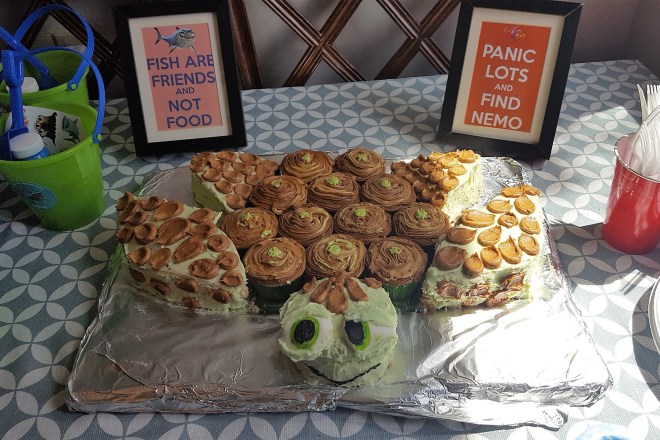
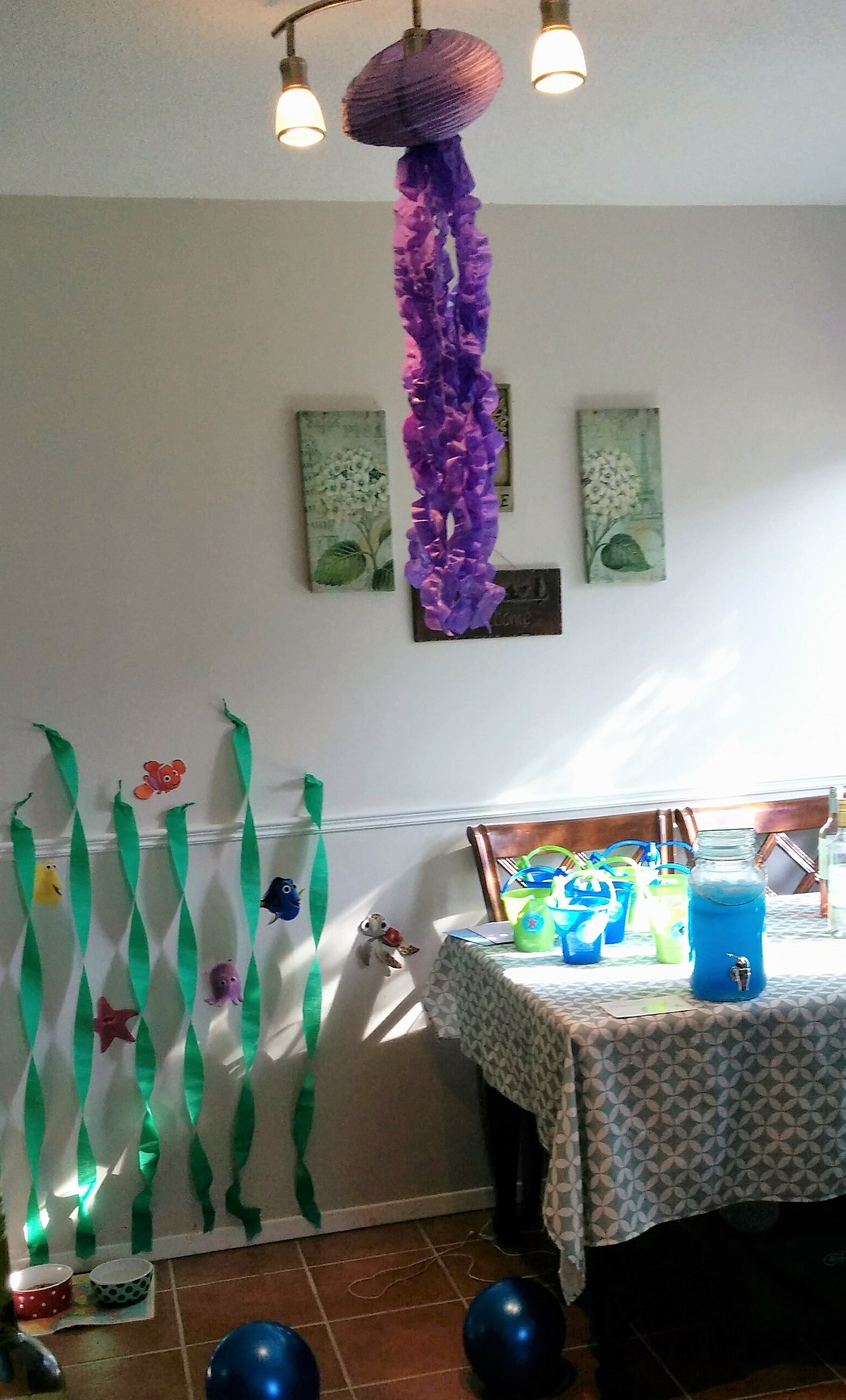
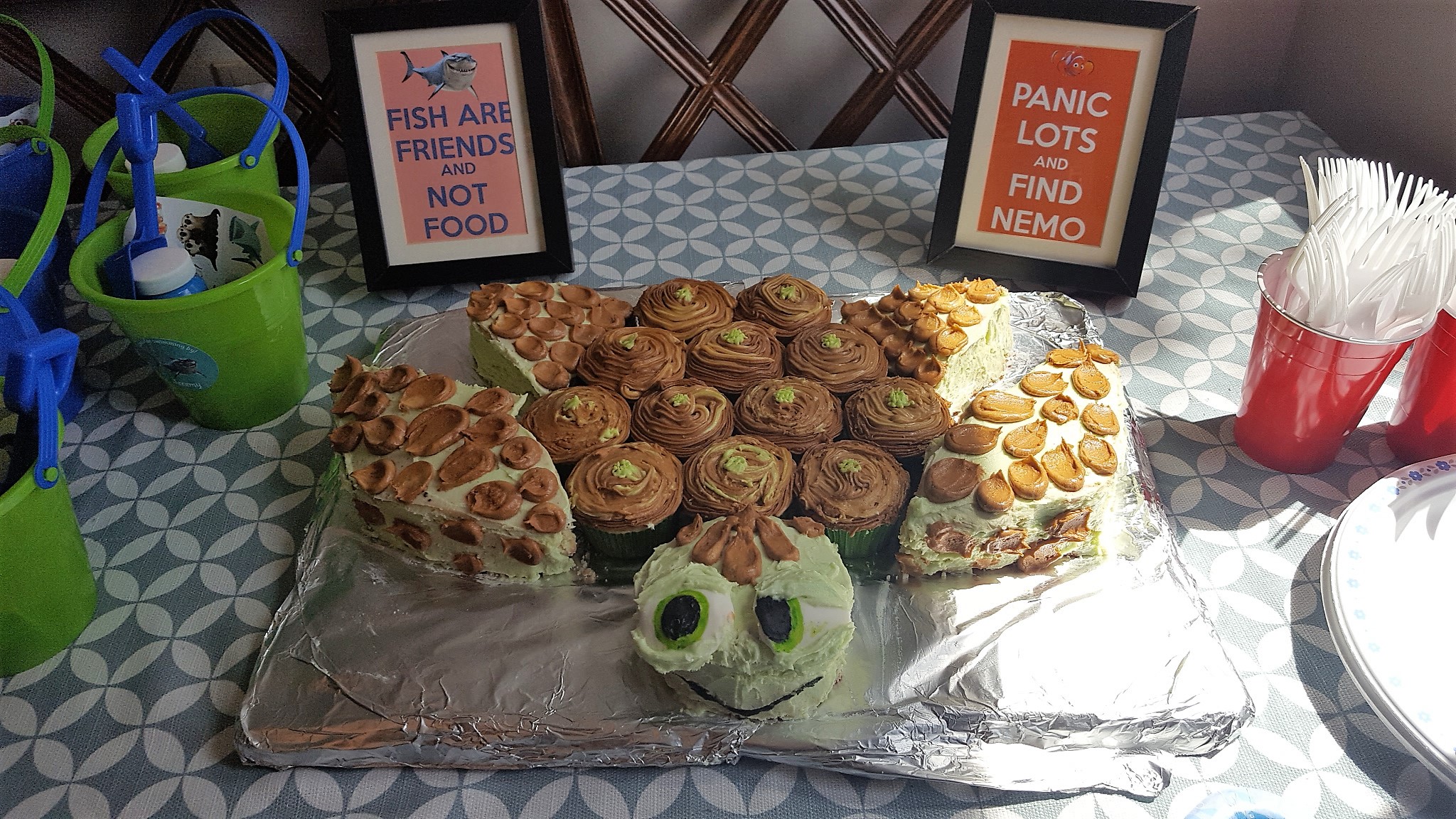
Geeking out on thinking up theme-y puns for the punch label and Pinning inspiration for a sea turtle cake doesn’t make me a good Mom. It’s not actually about my kid. In my case, doing these things makes me me.

What happens when I DIY is that I give myself permission to spend time doing something creative that makes me feel good. It’s sneaky self-care. It keeps me in touch with a part of myself that was there long before motherhood, and will be there long after my kids are grown and have kids of their own. For me, DIY-ing is not about trying to be something or someone that I’m not. It’s about getting in touch with who I am.

I think what makes any of us a good Mom is being ourselves, and showing that person to our kids.  So, you do you, mamas! The best Moms are the ones who do.

Lucas' Birthday 2016 2

Mom Things I Learn During Yoga #4: Do You, Regardless


Today, I took my youngest to Mom and Baby yoga. I second-guessed whether I should go or not, when it was getting close to the time to leave and I felt I wasn’t really “ready” to head out the door. I worried it wouldn’t be “worth” going because I knew he would just have to eat soon after we arrived, and maybe that would take up most of the class.

But we went anyway. Continue reading

LISTEN: Check out our interview with the ladies at “One Bad Mother”!

onebadmotherlogoHey Mamas!

We are so excited to share this week’s episode of our fav podcast “One Bad Mother”, which includes an interview with….you guessed it – the two of us!

Listen to the podcast here

We had a great time chatting with the lovely OBM ladies, and both came away with our heads buzzing with more ideas for Raise a Mother. Stay tuned!

We’d love to know what you thought of the conversation – add a comment or send us an email to share your ideas!


6 Things My Husband Taught Me About Mat Leave

There’s a lot of bad stereotypes about men caring for children. The Bumbling Dad is its own pop culture trope, and a quick image search for “when dad is left alone with kids” finds:

Screen Shot 2016-05-27 at 13.06.33.png

The caregiving bar is set pretty low for dads. They’re expected by society at large to be lazy, reckless, selfish, and to just generally not take the job seriously. With our first child, my husband and I shared parental leave. And on the surface, it might have looked like he fulfilled some of those stereotypes:

  • Frequently left lunch dishes on the table until they had to be cleared away to make room for our dinner? Check.
  • Enjoy whole days where nary a chore or task seemed to cross his mind? Check
  • Take more naps than I did when I was on leave? Check.
  • Feed our son more fries and Goldfish crackers than I would have been okay with? Check.
  • Take silly, sometimes scary photos/videos to show me at the end of a workday (like the time his friend captured a shot of my 10-month old being thrown so high in the air that Dad’s hands were entirely absent from the picture)? Check.

Yet, despite these things, I’m trying to take more of a ‘paternity’ leave myself with baby #2.  Because more important than any of those tangible differences are the bigger picture, truly invaluable things I learned from watching my husband on parental leave:

Continue reading

Mom Things I Learn During Yoga #3: Trust Yourself

Whenever I’ve done yoga, no matter the style or instructor, one thing has always been consistent. When it comes to whether a pose is being done ‘right,’ my teachers have always referred to each student’s best judgment and understanding of their own body:

Only go as far as feels right for you.

If it hurts, let yourself ease up a little.

Don’t worry about how anyone else is doing the pose.

yoga relaxation poseThese sentiments are important: if I worry about how other people do a pose, and focus on making my practice look like someone else’s from the outside, I run the risk of, at best, separation from the inner focus and peace I could enjoy from the practice, and at worst, really injuring myself.


My prenatal yoga instructor once described parenting as a lot like doing yoga. She said you have to put the “blinders on” and not pay attention to what anyone else is doing, but rather feel what’s right for you and your family. While it’s great advice, it’s not always easy to do this Continue reading

Flow & Resistance

I’ve learned many valuable things about parenting from my own mother. She’s given me tips and tricks for dealing with things like whining/arguments (ie. the ones she used on Shannon and I as children), as well as bigger-picture principles and approaches to motherhood in general. One of the simplest and yet most influential things I’ve learned is the mantra that she says informed all of her parenting:

“Say yes when I can, and no when I have to.”

When she gave me a no, I rarely made a stink about it, because I knew she would have said yes if she felt she could. I fully intend on using this approach with my own kids.

This little mantra has got me thinking about something else, though – not my interactions with my kids, but with my partner, as well as my general approach to life inside our house. While I don’t find myself saying no a lot, I do find myself resisting things, or intervening when it’s not really necessary. This resistance or intervention seems to be my default setting, and it doesn’t feel good. Continue reading

Overcoming “Be Careful”-itis

Roald Dahl quoteThis past week, I was listening to a recent episode of One Bad Mother. The conversation was about struggling with reflexively saying ‘no’ to your kids – even when you don’t really have a problem with what they want to do.

My son is young enough that I’m not yet struggling with being a ‘no’ machine, but I do find myself reflexively saying something else. My personal catch phrase? “Be careful”.

I cannot seem to stop myself from saying “be careful”. “Be careful with the cat”. “Be careful climbing on the couch”. “Be careful on the stairs”. “Be careful”. “Be careful”. “Be careful”. All. Day. Long.

Obviously, some of this is justified. My son is not yet two. We still have a baby gate for our larger staircase. He starts to lose his balance and run into things when he’s tired. He is definitely not at stage where he doesn’t need any reminders to be careful.

At the same time, my son is already a fairly cautious child, as toddlers go. He is not particularly anxious. He gets a kick out of being a little bit scared, like when his dad jumps out at him from behind a corner. But he is thoughtful and deliberate, and you can see him thinking through how to tackle a new feat before he actually tries to tackle it. When he was a baby, he routinely practiced new motor skills in the safety of his crib before he would dare to try them anywhere else.

I, on the other hand, was an overly cautious child. My mom had to convince me to let go of her hand in the grocery store when she needed both of her hands to lift something (or to stop my sister from running off). I was scared of climbing and hated hanging upside down. And while I would not consider myself an anxious adult, I do still fall into the camp of: “I’m cold, so you need to put on a sweater”.

It’s definitely not my favourite part of myself. Even as a kid, I wished that I could find a way to just let go a bit. Now as a parent, when I hear myself say “be careful” for the seven-hundredth time that day, I can’t help but wonder if my worrying tendencies are at risk of stifling my son’s independence.

I feel like Marlin in the movie, “Finding Nemo”, the parent whose over-cautiousness is holding back both his child and their relationship. He tells his friend Dory, “I promised I’d never let anything happen to him”. Dory responds, “Hmm. That’s a funny thing to promise. You can’t never let anything happen to him. Then nothing would ever happen to him. Not much fun for little Harpo.”

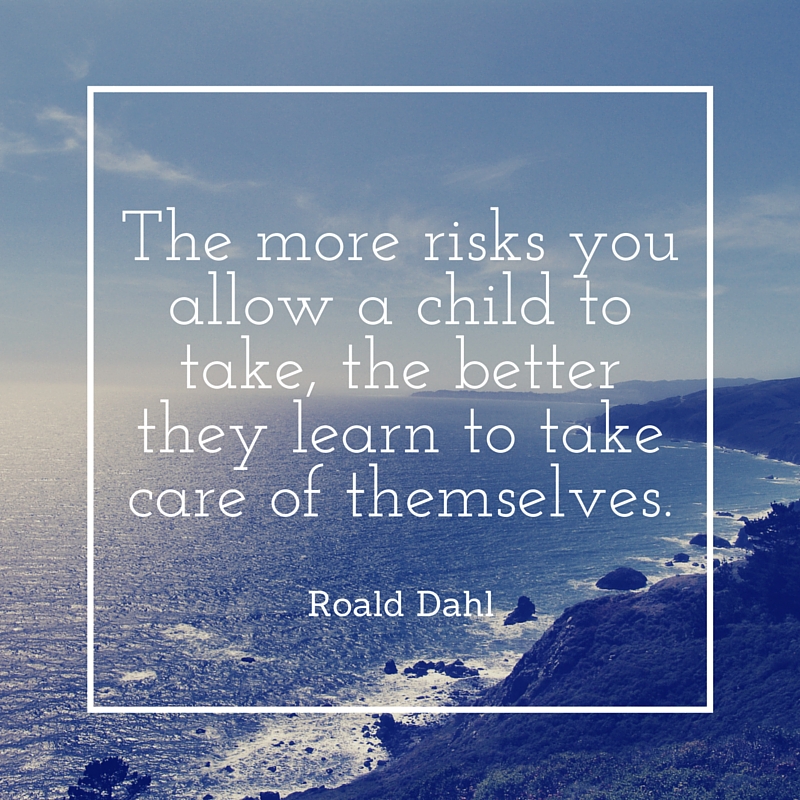
Not much fun, and not a great way to learn, either. Roald Dahl once said “The more risks you allow a child to take, the better they learn to take care of themselves”. This makes a lot of sense to me. After all, who among us doesn’t credit our biggest risks and/or failures with our best learning experiences? Either we rise to the challenge and boost our self-esteem in the process, or we find out what doesn’t work and try to do better next time.

And this is really what I’m talking about when I’m thinking about ways to get over my “be careful”-itis. I’m not going to avoid saying “be careful” when my son could really hurt himself or when he can’t reasonably be expected to understand the potential consequences of his actions. But I do want to try to avoid reflexively saying “be careful” in circumstances that he can navigate on his own.

Maybe it’s ok for him to learn that if he’s not paying attention to what he’s doing, and a board book lands on his foot, he probably won’t like it. And he’ll learn to take better care of himself the next time he’s at his bookshelf. I mean, how else does a little bird learn to fly than to start by falling? It’s not like mama bird kicks them out of the nest right from day one. She watches and waits until they’re ready. After that, there’s really no other way to do it.

Even typing this makes me feel a bit guilty and gets the worry machine going in my head, so I know it’s probably something I need to work on. In the meantime, I’m just going to try to channel my inner Dory and just keep swimming.

Baby Bird Try To Fly

Book Review: My 2 Favourite Parenting Books

If you read my previous post, you’ll know I have a problem with parenting books, at least the ones that present like self-help ‘manuals,’ implying that our kids are one-size-fits-all, that there is some ‘magic’ that will get your child to [insert your particular parenting struggle here], and ultimately, just making you feel bad about yourself when the ‘magic’ doesn’t work.  But as promised, I said I would write my next post about two books I have actually found very insightful and helpful in my transition to parenthood so far, instead of just ranting. Here goes.

The Books

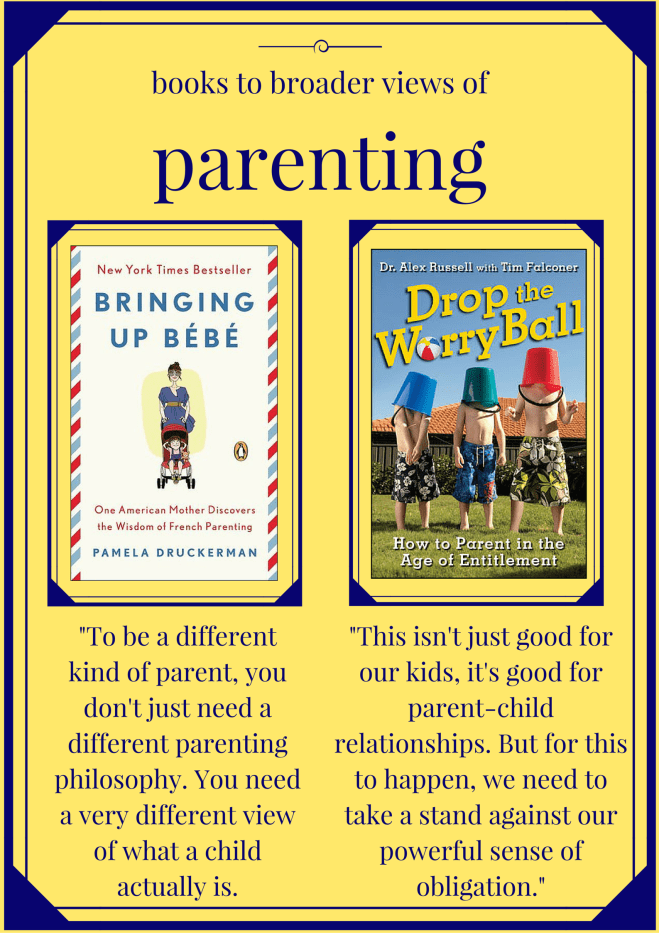
bringing-up-bebe coverI’ve mentioned book #1 a few times on this blog already: Bringing Up Bebe by Pamela Druckerman. An American journalist raising young children in Paris, Druckerman notices that “French children sleep through the night at two or three months old. They eat braised leeks. Their parents sip coffee while the kids play by themselves.” Naturally, she wonders what the French are doing differently from American parents, for whom these things are definitely not the norm, and sets herself the quest of figuring it out. I found her book engaging, funny, and fascinating from the first time I read it as a newly pregnant lady, and I find something new every time I re-read it.


9781118124949_cover.inddBook #2 is Drop the Worry Ball by Alex Russell, which delves into the muck of the contemporary North American family situation that so starkly contrasts to the French reality I read about in Bebe: sleeping troubles with much older kids, rampant picky eating, parents who can’t seem to enjoy any adult time if their kids are awake… He addresses the reality that trials like these are not only culturally accepted as inescapable facts of being parents, but worse, topped with a self-sacrificial badge of honour for accepting and slogging through them. I saw Russell speak at a conference this year, and was struck by his candour, his clarity, and the refreshing good sense he brought to the topic. I knew immediately I wanted to get his book out from the library, and am I ever glad I did!


Now, as I wrote in my last post, what I like about these books is their broader, less instructional approach to parenting. In Bebe, Druckerman doesn’t find as many easily-replicable ‘tips’ among the French experts as she hopes. When she tries to simplistically implement a phrase or action that she sees French parents use with easy success, it often doesn’t work. As she tackles each aspect of parenting, she discovers that the French don’t just do things differently, they have a whole different philosophy around parents, children, and families. In Worry Ball, even though it has a ‘how to’ subtitle, and even though Russell is a practicing psychologist who describes many case studies with tangible examples, there aren’t many instructions. He insists the “professionalization of parenting” via “parenting guides” has led to the “steady erosion of parental confidence,” and so deliberately keeps the tips to a minimum, instead hoping to help readers rethink the parenting role in a more holistic sense for themselves.
books to broader views of parenting

So Why Talk About These Books Together?

While I didn’t expect this when I started reading Worry Ball, I actually find these to be great companion books, for a couple of reasons. After all, they address the same core issues that seem to plague North American parenting these days:

  • family lives revolving entirely around children’s desires and “happiness”
  • parental couples who have little time to focus on themselves, or each other
  • troubling levels of entitlement, disrespect, and non-resilience among children
  • parents who feel they have zero control over behaviour or tantrums
  • immense cultural pressure to do parenting “right”
  • heavy feelings of guilt/responsibility for your child’s behaviour

The list could go on, but you get the idea.

What I love about reading these books together is that they tackle the same issues from different angles, giving me a more complete picture, and often, more reassurance.

Angle #1: Relatability

Druckerman brings the vantage point of a mother, an everywoman who struggles not only with her ordinary parenting interactions, but also with not understanding how we/she got here in the first place. (Why is there so much pressure, such guilt? Why is it so difficult to convince her kids that she is in charge? And why is it so hard to break out of these patterns?) She explores the work of parenting experts, but is often frustrated, as I was at first, too, with the fact that French experts, and even everyday French parents, seem to wax poetic about how to think about sleep or understand a child, when all we’re looking for is an answer to, “So what do I DO when my kid is acting up/refusing to eat/waking at night?!?!”

This is where Russell’s book comes in handy. Coming at the same issues as a long-practicing psychologist, he’s been helping parents grapple with these troubles for a long time. As such, he’s seen enough examples to sift out some answers to those “how did we get here?” and “why is it so hard to break out?” questions. He includes not only cultural/historical explanations parent-child relationships, but also many stories that highlight these theories in a more concrete way. He is also a parent, but as he mainly seems to hold an expert role in this book, it can feel easy to dismiss his ideas: “Sure, it sounds easy coming from him, but he’s an expert – that would never work with my kid.”

So Russell’s book helps to flesh out some of the “but how does that apply in my real life?” questions that Druckerman’s book might leave a little bit fuzzy, while Druckerman’s eventual successes give hope that even non-expert, regular parents can figure this stuff out.

Angle #2: Geography

Druckerman, though American, is living in France. This physical removal allows her to get outside the feeling of being ‘fated’ to follow the cultural norms and pressures so problematic to North American parenting. It’s because she’s outside this frame that I can suspend my disbelief that such transformation is possible and the reality she describes actually exists: a place where parents don’t do night wakings as a matter of course with three-year-olds, a place where kids can bake whole cakes for themselves on Saturday mornings but not freak out when they can’t eat them until 4pm. Unfortunately, this also means her successes can be easier to write off as plausible/possible only in the magical otherworld of Paris.

Russell, on the other hand, isn’t writing from the outside: he hasn’t escaped! He’s (as are his case study families) parenting deep ‘in the trenches’ of the problems at hand, yet they are able to make some positive change for themselves. He doesn’t shy away, though, from being honest with you that getting out of the traps that seem so common, or even inevitable, will be very difficult. He says doing so requires going against the flow, knowingly subjecting yourself to judgments from parents and others who don’t share your views. He validates the (perfectly reasonable) fears you might have about going against the grain as he encourages you to do it anyway.

So Russell gives us a ‘what is’ view of the trials we face as parents and admits that it’s going to be painful to get out of, while Druckerman gives us more of a ‘what could be’ big-picture view, based on what she’s seeing firsthand in France. From reading them together, I get both the realistic validation of the struggle ahead, but also the optimistic hope that a better way exists, not just for one or two people, but that it’s even possible on a more communal level.

Angle #3: Who Is This Really About?

The last helpful way that I see these books as great complements is in their focus within the family unit. Because when we start to talk about these issues, particularly under the shadow of the self-sacrificial-parenting-badge-of-honour, it can get hard to sort out why you really want to make a change. Creeping doubt questions can start to trickle into your brain: do you really think your child will benefit from sleeping later, or are you just a selfish adult who wants to sleep in? 

Druckerman seems to focus more on the benefits to parents of moving away from the North American model (or, at least, from my biased North American mind, it seems that way). While she does say it’s good for children’s development to learn that they are not “the center of the universe” and that they “can’t always have their way,” there seems to be an old-school, old-world harshness to these sentiments. We’re living in the age of “attachment” parenting, coming off the heels of the “I’m special” generation, so some values that the French seem to take for granted – that adult time is sacred, that interruptions from children are unacceptable, etc. – seem unpalatable here, and certainly not something you could claim this side of the sea without great scrutiny/judgment. Deep down, they feel so refreshing and reasonable… but you just can’t help the feeling that it’s somehow selfish to actually admit it.

Russell’s ideas focus more on the benefits to children when championing these same lessons. He goes further and insists these lessons are not only beneficial, but necessary for kids’ development. He shows convincingly how we’re actually doing our kids a huge disservice by not making a shift away from our current cultural parenting expectations and by allowing ourselves to be sucked into contemporary parenting traps.

So Druckerman appeals to and validates any underlying (seemingly selfish) reasons I might have for not wanting to succumb to obligation/entitlement/attachment parenting, while Russell rationalizes these feelings and provides confident justification for my resistance efforts.

What About You, Dear Reader?

These are just my top picks for broadening my parenting perspective… what are yours? Leave them in the comments, because we here at Raise A Mother would love to check them out!