My Problem with Parenting Books

My husband and I were saying over dinner last night that it would be interesting if people organized their bookshelves by the year each book was added to their collection. (Alphabetization-addicts, like Shannon here at Raise a Mother, don’t panic – I’m not actually doing it!) But it would be a neat way to see the progression of your reading habits – how topics, authors, or genres of interest have shifted over time. If we did this, our newest section would be dominated by Parenting Books.

Parenting Books Collection

My bookshelf happens to be ordered so all Parenting Books are in the same section as it is.

I’ve acquired some of these books as gifts, others as hand-me-downs, and a few I’ve bought. The main issue I have with parenting books as a category is that too often a parenting book reads as a ‘manual,’ and this is, frankly, bullshit.

One book on this shelf (I won’t name names), started out great – it was reassuring and soothing to me as an anxious parent who wasn’t getting any sleep, as it explained that all babies can smoothly be taught to sleep through the night, if only you take the correct steps. Hah hah! Hah! I can scoff in retrospect. Desperate as I was, though, I devoutly followed the instructions laid out for me so clearly and reassuringly by the serene-looking writer on the book’s cover. At first, it seemed like it might work, but within a few weeks, my son’s sleep and mine had both deteriorated significantly. We were worse off than we had been at square one. We gave up on the expert advice of the author, and upon returning to our previous situation, it suddenly didn’t seem so bad (so maybe this was a ‘win’ after all?).

Now of course, this book was a bestseller because its advice had clearly worked for many people – the person who gave it to me even swore by it from personal experience! But for some reason it didn’t work for my kid, and when I stop to think about it, it makes sense that it didn’t. Because the author doesn’t know my kid. How could I expect that she knows exactly what will make him fall asleep and stay asleep all night long?!

Our children aren’t products. They’re not manufactured. They’re not one-size-fits-all. If they were, wouldn’t somebody have already written the perfect manual for raising a “Child,” and wouldn’t we all just be given a copy from our doctor or midwife upon birth and sent on our merry way?

The problem is, manuals, tutorials, and clearly defined steps are the way of our world today. Need to know how to change the bulb in your car headlight? Speed read? Poach an egg? Do a complicated braid? Pose a selfie? There are video tutorials and listicles with step-by-step instructions on how to do all of these things, and everything in between. This can be great: you can save money on mechanic service, whip through required reading, make delicious breakfasts, satisfy a kid’s Frozen obsession, and avoid ever again publicly sharing a photo of the insides of your nostrils, all without too much risk, because probably, if you follow the instructions, these sorts of outcomes are fairly reliable (Pinterest fails aside, which are, incidentally, a delightful waste of Internet time).

Unfortunately, we’ve become so wired to expect the ability to just follow-the-instructions and get reliable outcomes, that this trend has spread to things that by nature just aren’t that reliable. So the web is also full of listicles and how-to-steps on things like personal relationships, finding self-worth, being happy, and yes, raising children. Wikihow, for example, whose tagline is “How to do anything” (really?) has a whole relationship section:

Wikihow relationships

I seriously question that a single article is going to be able to reliably “restore my faith in humanity” if it’s truly been lost. Life’s just not that easy.

Our kids are individual people, and working with them on complicated things like anxiety, adapting to change, or managing their emotions (which, quite possibly, are at the heart of some struggles like not being able to sleep through the night), is likely going to be a process of trial-and-error, just like it is working on these things with adults.  Assuming that a simple checklist of steps is going to ‘fix’ or ‘solve’ such complexities, or reduce the need for us to actually struggle through teaching a tiny separate person how to be in the world, just seems silly in this light.

So what books do I think are useful?

Well, some of the tangible advice ones are, sure. For example, I found great, clear ‘instructions’ and tips that fortunately worked out well for me and my kid in books like Solve Your Child’s Sleep Problems by Richard Ferber, or Baby-Led Weaning by Gill Rapley and Tracey Murkett. But I firmly believe now that these just happened to work for our particular context, our family, and our child, and I wouldn’t presume to tell another parent, “Oh, you definitely have to try this because it’s magic!” Sadly, I’ve heard too many parents express just this sentiment in real life and seen even more parents do so in the online blogging world. There is no one-size-fits-all magic – don’t believe it for a second, as glorious and reassuring as it sounds. If a particular tip or book works for you, embrace it and cherish it – just remember that this is a happy coincidence, and maybe let yourself feel a bit smug that you found your match, you lucky duck!

The books I’ve found the most useful, it turns out, are the broader ones. The ones that don’t claim to have any specific “answers” for the difficulties I’m facing, but instead encourage me to rethink my whole perspective on parenting, to allow myself to look beyond the scope of the particular irritation of the moment, to consider my kid and my relationship with him not as a collection of ‘symptoms’ to be addressed but in a more holistic way, for the long-term.

Yes, this requires more time to get through. It requires more time to sit and let the ideas sink in. It requires me to do the connect-the-dots work of figuring out how the bigger ideas presented fit into my life and my parenting ideas. It certainly doesn’t allow me to do a quick reference and fix a crisis in the moment. But it also has been, at least for me, a hell of a lot more effective to actually making change that feels better in my house, my family, and my life.

Now I know you might be thinking, really, Lindsay, that’s the end? Thanks for nothing helpful today... so hopefully I can make that better. This is sort of a two-part blog, because my next post is going to describe the two books I have personally found most useful, and how I have found them to be great companion books for one another. So in case you’re looking for some interesting reads on parenting, but like me, you’re disillusioned with the ‘manual’ approach, stay tuned! I promise to give you more.

 

3 Reasons I’m (Mostly) Ignoring My Due Date

A pregnant woman’s due date can mean a lot. It’s the standard question she gets from strangers. Inputting it online procures alerts about what fruit or French pastry her baby resembles in size each week. It charts her ‘progress,’ determining the topics of each medical appointment and when she can have that long-awaited ultrasound. It’s how she plans her last day at work or a baby shower. It might even be the same as a holiday or a friend’s birthday, which can heighten its excitement. It helps to prepare for a MAJOR event in her life.

So why am I trying to ignore this important date the second time around?

Well, with my first child, my due date was 8 days after my sister’s due date, which was VERY. FREAKING. EXCITING. I cannot stress that enough, seeing as these were not only first babies for both of us, but first grandchildren in our family. Our joint family baby shower involved a decorated calendar where everyone placed bets on when each baby would be born, and there would be prizes! Throughout our pregnancies, our symptoms were almost like clockwork.  What she experienced one week, I would a week later. It was wonderful to share all those details with someone whom I knew got exactly what I was talking about.

Then my nephew was born – 10 days early. So naturally, once he had made his arrival, my brain went into hyper-anticipation-readiness mode: That means it’s only a week until I go into labour!!! Of course, in the way that it does, reality kicked my expectation-having ass with nearly another month of waiting. Our boys’ birthdays are 27 days apart.

So while due dates are all very well and useful for some things, here are the three reasons I’ve been thinking of a ‘due month’ this time around:

3 ReasonsI'mIgnoringMyDue Datethe 2ndTimeAround

#1. It keeps everyone else’s (completely understandable and unintentional) pressure at bay… which helps me to feel less stress. 

When asked with baby #2, “When are you due?” my most common response has been “Not until the end of March,” or “Sometime late March/early April.” No one’s really been counting down the way they were the first time (including me!), which has reinforced in my own head that there is no reliable countdown to do, so therefore I don’t stress about it. Sure, it was a little embarrassing at prenatal yoga to be the only one in the circle who usually couldn’t remember how many weeks along she was, but it’s been kind of nice when even close friends ask casually, “So wait, when’s your  actual due date again? I forget.”

#2. I can truly enjoy the early days of mat leave this time around.

With my first pregnancy, I was a bundle of nervous excitement from the moment I left work on my last day. The nine days I went past my due date were the most impatient I have ever known, as each day I woke up thinking, surely it’s got to be today!  I expended most of my energy trying every natural induction remedy in the book: massage, stretch and sweeps, spicy food, hours of bouncing on an exercise ball, copious amounts of red raspberry leaf tea, as much sex as I could get my body positioned for, and as long and brisk walks as I could handle at a 40-week waddle. Also, certain that the wee lamb was going to come by his due date (if not early!), I had long checked off my to-do-before-baby-comes list. I was impatient to start using all those clean baby clothes and strapped-in carseat, not to mention eating the delicious freezer meals my mother-in-law had stocked in my kitchen. This time, I’ve been off work for a week and there are still things on the to-do list that haven’t been done, but I figure I’ll never know when it’s down to the wire, and it could still be weeks away, so why not just take a walk, get a pedicure, or read a book for now?

#3. It turns out maybe it’s not possible to know when your ‘due date’ should be, anyway.

A recent study on women’s gestational length suggests that why babies don’t generally come on their ‘due dates’ might have less to do than previously thought with errors in calculation or inability to pinpoint when conception actually took place. Instead, the study found that even when you know exactly when a woman conceived, the length of a normal, healthy pregnancy still varies by as much as five weeks. Five weeks! Knowing this last time, instead of thinking that babies who don’t come on their due date are either ‘early’ or ‘late,’ probably would have kept me from some of my impatience and stress about it. Medical issues aside, I imagine the same could be said of mothers whose babies come ‘early,’ and so they may have different worries or stress as a result. When I think about it, it makes sense that there would be this much variation. Women are all different, our bodies are all different, and our babies and experiences of motherhood are certainly all different, so why would we expect pregnancy length to be an exception? Maybe this is just another (small) example of how we can do better on accepting our diversity as women and mothers, rather than feeling pressure to fit into some standard mold.

So if you want to love your due date, love it. If you want to live by it and build to-do lists around it, power to you! But if it ends up stressing you out, making you impatient, or causing unnecessary worry about being ‘early’ or ‘late,’ then perhaps remembering that a ‘due date’ is really more of a ‘due month’ might help.


Re-Thinking “Counting to Three”

As you may remember from an earlier post on living in the moment while on mat leave, I love Pamela Druckerman’s book, Bringing Up Bebe (I told you it might come up again!). In her comparison of French- and American-style parenting, she mentions the old “count to three” tactic that I bet most of us are familiar with. She writes that a particular French caregiver she observes “counts to three” to get a child to cooperate, but describes a difference in the tone and attitude of this counting from what I was expecting: less a warning and more an allowance of time for the child to get on board with the program and make a sage (calm and reasonable) decision.

I remember using the “count to three” method on my brother, younger by thirteen years. When I said “I’m going to count,” or when I heard either of my parents say this phrase, there was a definitive warning tone, an escalation of the resistance and conflict between us, an implied threat of pulling out the ‘big guns.’ In essence, this phrase meant, “you are going to do what I have asked whether you like it or not, so you can either save face by doing it before I get to three or you can endure the humiliation of having me enforce it upon you.” It’s the parenting equivalent of checkmate.

Now I don’t think that either I or my parents did anything unusual or extreme in counting to three before enforcing the reality of whatever we had asked my brother to do (likely multiple times) before resorting to counting. Most parents I can remember growing up “counted,” and I bet most of us can remember somebody counting to get us in line at some point or other. It seems to be a very effective strategy overall.  My in-laws told me all they had to do was tell my husband, “I’m going to count…” for him to comply. They didn’t even have to get as far as “one.” The fear of “three” can be almighty.

But reading about this anecdote in Druckerman’s book made me think about a different counting memory, too:

Back in our early years of dating, when we were doing the Toronto-Montreal long-distance thing, my partner and I would do our own version of counting. Whenever we knew we had to do stop doing something  we wanted to do (usually snuggling under the covers in one of our freezing student apartments) in order to do something we didn’t want to (usually brave the Canadian winter so one of us could get back on a train home), we would count. We would count to ten, or twenty, taking turns saying alternating numbers. We were slow about it, breathing calmly and speaking softly. It was just a way to savour the last seconds  of doing what we wanted, of a nice moment, an experience, before resigning ourselves to the harsh, intrusive world of reality where we had to leave each other. And it really did help to make that transition easier.

So between this memory and Druckerman’s observation of the French caregiver, I’ve been trying to use counting in this light the past week with my toddler. And so far, it seems to work (though as with all new attempts at parenting strategies, I feel a need to cross my fingers as I write that!). When my twenty-month-old resists a necessary task, this is my script, said at his level, in a quiet, gentle tone that implies I have confidence he will understand the reason behind what we’re doing:

“Arlo, it’s time to cooperate now. So Mommy’s going to count to three, and then you need to [insert required action here]. One… two… three. Okay, [insert directive here].” Then I let him have this prepared chance to do it on his own.

So far, it’s worked to get him to lay back for a diaper change and stay still instead of wrestling. It’s worked to get him to let me clean his face after supper without a fuss (which normally is a drama). It’s even worked to get him to calmly place a toy in my friend’s bag that belonged to her son, and not, to Arlo’s despair, to him. I was most shocked at this last one!

When he complies, I’ve been acknowledging his cooperation with a  “Thank you,” or “You did it,” and offering him a high five, which he loves. When he still resists, I repeat gently that it’s time to do it, and talk him through the action as quickly and calmly as possible. Even in these instances, once the unpleasant is over (as happened with taking a shirt off yesterday), he hasn’t stayed mad about it or thrown a post-action tantrum the way he used to when my tone had been more forceful and demanding.

These interactions feel good on my part because I get to express empathy with my kid, instead of frustration or the sense that I’m ‘at the end of my rope.’ I’m hoping he somehow feels validation in his resistance, that he feels I ‘get’ why he doesn’t want to comply, and that I understand how much it sucks to not get your way. Because I do. We all do. And even though my job is to sometimes enforce the harsh intrusiveness of reality against whatever he might desire in a particular moment, it seems to be much less of an ordeal for both of us when I turn a moment of resistance into a moment where we’re on the same team, even if I can’t give in to his whim.

So I’m going to keep trying to “count” on this strategy with my little guy, and we’ll see how it goes. As I said, it seems to be working so far, but if parenthood has taught me anything, it’s that things can shift unpredictably and instantly, so I’ll keep you posted!

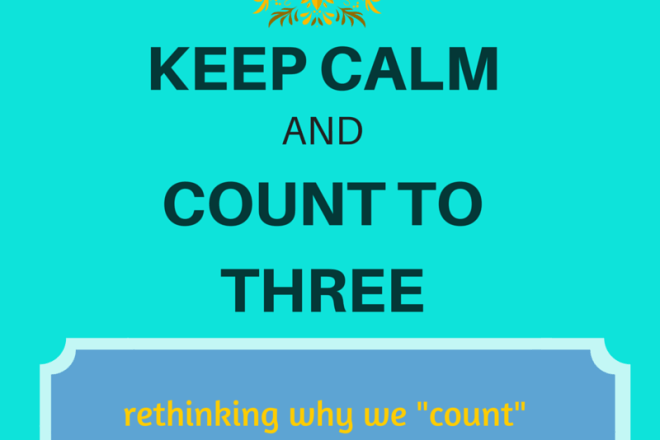
KEEP CALM and COUNT TO THREE img

Women’s Day in the Air

As some of you may know, March is Women’s History Month and March 8th is International Women’s Day. Here at Raise A Mother, we spend a lot of time thinking about women and how best to support them, so Women’s Day holds a special place in our hearts.

I’ve recently been trying to make a concerted effort to take self-care more seriously, and set aside time for myself. One way I’ve found to incorporate this time into my day is by listening to podcasts on my commute to and from work. I get to clear my mind and listen to whatever I’m in the mood for.

Incidentally, all of my favourite podcasts at the moment are hosted by women. So, to start off this women-focused week, I thought I’d share some of these fabulous programs with all of you. I hope you’ll share some of your favs with us too!

FAV MAMA PODCAST: ONE BAD MOTHERonebadmotherlogo

From the hosts:

One Bad Mother is a comedy podcast hosted by Biz Ellis and Theresa Thorn about motherhood and how unnatural it sometimes is. We aren’t all magical vessels!

Join us every week as we deal with the thrills and embarrassments of motherhood and strive for less judging and more laughing.”

Highlights: I look forward to the new episode of One Bad Mother every week. This podcast has a very similar theme to what we try to do here at Raise a Mother – support mothers as the unique women they are, without judgment. I especially find that the weekly genius and fails are a great reminder that none of us are alone in this epic motherhood adventure.


FAV CURRENT EVENTS PODCAST: THE CURRENT WITH ANNA MARIA TREMONTICBC_Radio_thecurrent

From the host: 

“The Current is a meeting place of perspectives, ideas and voices, with a fresh take on issues that affect Canadians today. Based in every major region of the country, our team of journalists think locally and globally. If major news is breaking, we’re on it. We bring new insight to stories that Canadians are talking about now, and we uncover stories they’ll be talking about next week and next year.”

Highlights: The Current is a radio show that airs daily on the CBC, Canada’s public broadcaster. They cover a wide range of stories, both based in Canada and around the world. I love the way this show gets my brain going in the morning. As an added bonus, the podcast version of the show is divided up into the day’s different stories, so you can listen to the parts you’re most interested in if you don’t have an hour available to listen to the whole show.


FAV LADY-FOCUSED PODCAST: STUFF MOM NEVER TOLD YOUstuffmomnevertoldyou

From the hosts: 

“Hosted by Cristen Conger and Caroline Ervin, Stuff Mom Never Told You is the audio podcast from HowStuffWorks that gets down to the business of being women from every imaginable angle. Fueled by boundless curiosity and rigorous research, Cristen and Caroline are girls-next-door gender experts who skillfully decode the biology, psychology and sociology of ladies and gents, from their evolutionary past to millennial present, to better understand all the Stuff Mom Never Told You.”

Highlights: I’ve only recently discovered this podcast, and already I’ve learned so much. The hosts really delve into their topics, but still manage to make intensive research interesting and engaging. Their newest episode is about the history of International Women’s Day – I can’t wait!


FAV ENTERTAINMENT PODCAST: SERIALserial logo

From the host: 

“Serial is a podcast from the creators of This American Life, hosted by Sarah Koenig. Serial tells one story—a true story—over the course of a season. Each season, we follow a plot and characters wherever they take us. We won’t know what happens at the end until we get there, not long before you get there with us. Each week we bring you the next chapter in the story, so it’s important to listen to the episodes in order.”

Highlights: I was a latecomer to Serial, so many of you may already know about this amazing show. If you have not yet discovered it, get ready for the urge to binge-listen. Each episode is so well written, it leaves you eagerly awaiting the next.


Tiredness, TV, and Tantrums

One of the best-loved things in our house (at least by one member of the family) is Thomas the Tank Engine. We have two identical toy Thomases who ride on the classic wooden track. We have a big toy Thomas that our little guy fell in love with at the local consignment shop when Daddy was buying him waterproof mittens. Thomas comes up frequently in family conversations. Thomas often sits on the dinner table to watch our son eat, perches on the counter at bathtime, comes upstairs to read stories before bed, and gets a kiss goodnight once the stories are finished. Happy dancing ensues if we play his 30-second instrumental theme on repeat on Apple Music. If we had a stuffed Thomas, I think Arlo’s faithful elephant (“Elly”) would be quickly discarded as a sleeping companion.

Unfortunately, we’ve also made Arlo aware that there is a TV program of Thomas, which has resulted in our first ongoing struggle with tantrums. We’ve generally tried, since our wee one was born, to limit screen time to a bare minimum (ie. when he was sick, getting his nails cut, or at someone else’s house), and this has been fairly easy to do at home, since we don’t have cable (we’re Netflix people), and our only tv is in the basement, which isn’t baby-proofed and therefore we don’t spend much time with him down there at all.

But, as Mindy Wood of PurposelySimple.com observes, TV is sometimes entirely too accessible and helpful an option for childcare. As she explains, “We all know that screen time in excess can be harmful to infants and toddlers, […] so why are so many young children still watching too much TV? Well, because parents are tired! [and] it’s totally understandable to want a few moments of peace every day.”

I’m seeing lately how this is especially resonant if you’re a mom eight months into a second pregnancy… and not really able to do much mobility-wise with your toddler… or if you’re a dad and your partner is experiencing the aforementioned, so you’ve been assigned more of a single-parent role lately… and your kid is having trouble sleeping but at least when he wakes up at 5am on a work day, if you put on Thomas, you can lay down with your pillow on the couch and a blanket and pretend to still get more sleep until 6:30…

…And I’m sure many parents out there have completely different but just as valid and understandable circumstances that also, bit by bit, bring them to allow a little more screen time. It’s so easy to justify, too:

“It’s not like we’re letting him watch things with commercials.”

“It’s just a little bit here and there.”

“We’re going to let him watch TV eventually anyway, so it’s not so bad to introduce it slowly now.”

“It’s so snuggly.”

“It’s so PEACEFUL when just this short program is on!”

Even though Arlo didn’t watch every day, or even close to it, I knew things were headed out of a realm of control I felt comfortable with when one unusual afternoon, his grandma dropped him off  with me after caring for him for the day and he cried because he wanted to go straight downstairs to watch “Thomas” on the “Fee-Vee” (TV), and I told him that wasn’t an option.

A few mornings later, when Arlo decided 4:50am was an appropriate time to wake up, his Dad tried to get him to go back to sleep but eventually resorted to the Very Useful Engine (oh, so useful indeed!), as that would be less stressful pre-6am for everyone within earshot. Unfortunately, this backfired when it was finally time to get ready for the day, and Arlo threw an absolute fit about Thomas being turned off – a fit complete with wailing, leg-kicking, and ultimate despair that lasted through changing his diaper, choosing clothes, putting on his shoes, and finally getting out the door. We parents both managed, somehow, to keep our cool during this fit, and I heard myself saying, repeatedly, “Well, Arlo, if you can’t handle it when Thomas gets turned off, then next time we won’t be able to turn him on at all.”

Right now, my biggest issue with screen time for a toddler isn’t the recommendations from experts that kids under two shouldn’t have screen time at all, or that too much video-watching inhibits communication and social skills, or that it decreases attention spans or reduces kids’ abilities to explore and discover through active play. It’s that it turns my kid into a whining, wailing, tantrum-having toddler in a way that nothing else really seems to do. He simply doesn’t seem mature enough to handle screen time.

The tough part, is, of course, that in moments that are already difficult, or leaning toward a possible tantrum, screen time is a pretty surefire way to derail that train – at least for the moment. Other options for distracting, re-directing, or otherwise dealing with undesirable behaviour all seem to require a lot more energy, which sometimes, you just don’t feel you have as a parent. (Wood actually has some helpful, tangible ideas in her piece on raising a low-media child without going insane, but they do require efforts in pre-organization and maintenance that switching on a video just doesn’t.)

I’d like to get rid of Thomas (the video version) altogether as a coping mechanism for the trickier moments of parenting, but it seems unrealistic to do so. Do we really have the willpower, even in moments where we feel depleted already, to avoid that easy fix? What if we just do it even less often – is it really so bad if it hardly ever happens? Shouldn’t we really just cut ourselves some slack in this particular period surrounding the arrival of a second child into our family? We’ll have plenty of time to figure it out later, right?

I don’t have any answers today, so I’m more looking to my fellow parents for your thoughts. What are your theories on screen time with toddlers/young children? How do you use TV, or determine when your kids can watch it, and how much?

Looking forward to hearing from you!


Parenthood is Not a Project

I’m re-reading my favourite parenting book: Bringing Up Bebe by Pamela Druckerman. This is the third time I’ve read it in under three years, and I love it because it’s funny, it’s relatable, and each time I read it, I’m struck by new things. So don’t be surprised if I bring up Druckerman’s ideas in more blog posts in future.

Today I was reading her chapter on “The Perfect Mother Doesn’t Exist,” where she talks about how American-style (and I’d say, Canadian-style, too) parenting involves an intense amount of “concerted cultivation” – in other words, parenthood is a project. Druckerman admits that as an American living in Paris, “my project is to make my kids bilingual, international, and lovers of fine cheese.” It struck me that perhaps one of the reasons I had great difficulty during my first maternity leave is that I too, thought of my time at home as a project.

I’m not surprised I viewed mat leave this way. Most of my life until that point had been a series of projects – from completing each class and each year of education until I was 22, and then continuing that ‘project’ mindset as I moved on through a series of contract jobs, buying my first house, and the nine months of my first pregnancy. All these experiences had definitive expiry dates, finish lines, and clear goals.

So of course I saw mat leave, with it’s defined months – six, in my case – as another project. I had an actual spreadsheet of goals, and I thought I was being very reasonable to only put one major item on the slate for each week. This didn’t work out so well for me. I did manage to check off most of my goals (probably because I had been so minimal with them in the first place), but I still felt like I hadn’t managed to accomplish much as my return to work neared.

Looking back now, I realize the problem wasn’t that I had tried to be organized, or that I had tried to ‘make the most’ of my brief time off work by having a clear idea of what I wanted to accomplish. The problem was that the point of that time wasn’t leave from work. The point of that time was my entrance into motherhood. I had been thinking about those six months as an isolated block of time, rather than as just the beginning of a lifelong experience with no expiry date, no finish line – the experience of being a parent.

Of course I felt I hadn’t “accomplished” anything – because my relationship with my child, my motherhood, my family, isn’t something to be “accomplished.” It’s something to be lived.

This isn’t to say I can’t have goals while I’m away from work this time around – I can, and I probably should, to keep connected to my independent adult self, who loves to-do lists and accomplishing things. But I won’t tie those goals to the finite period of my mat leave; instead, they’ll just be part of my life while I happen to be home every day, and they can and should go beyond my return-to-work date.

As I thought about this, I set aside my book, rubbed my big round belly, and promised baby #2 that this go round, our time together won’t be a project. We won’t try to accomplish things over the next year. We’ll just experience living with each other, getting to know each other, and cherish the fact that we have so much time to devote to the start of this new relationship that will last forever.

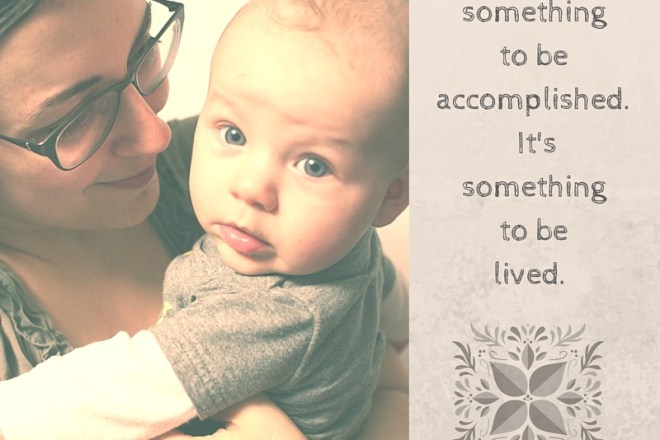
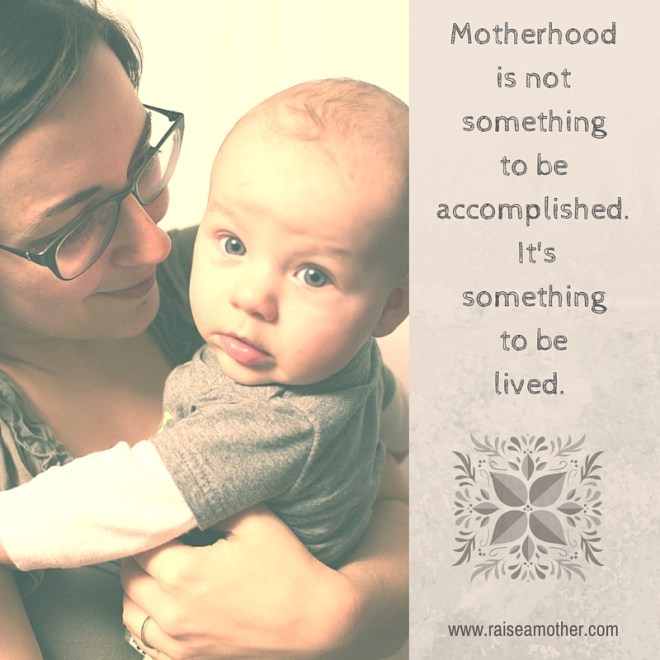
Motherhood is not something to be accomplished. It's something to be lived. (1)


Confessions of a Hot Mess: Hamster in a Wheel

hamster-wheel-03-600Hello, dear mamas. Long time, no see. Once again, I have been remiss and Lindsay has been holding down the fort here at Raise a Mother. She’s been doing a fantastic job, I’m sure you’ll all agree. If you haven’t yet read her post “Letter to my Post-Partum Self“, do. It’s lovely and thoughtful, just like her.

Lindsay also wrote recently about bonding, and about how many of us are allowing ourselves to become “too busy” to connect with the people in our lives, instead collapsing at the end of each day in front of a screen. Reading this post made me feel uncomfortable and guilty, though I know that wasn’t close to Lindsay’s intent when writing it. You see, I am the hamster in that wheel.

Ladies, I have a confession to make: I am a hot mess. I eat more than I should, drink more caffeine and wine than I probably should, and weigh more than I should. I don’t sleep, or exercise, or floss as much as I should. I may or may not have finished the last bits of peanut butter from the jar by pouring in some chocolate chips and then scooping it out with a spoon (I totally did).

My absence from this blog comes down to one thing – I am terrible at taking time for myself. I work through my lunch break on a regular basis. I feel a compulsion to make sure that all my chores are done before I do something fun. Of course, with a toddler around, my chores are never done. They’re on an endless loop. I constantly feel “too busy” and collapse on the couch at the end of the night.

Here’s the thing, my lovely mamas: all things considered, I’m doing ok. I might personally feel sometimes like a human disaster, but I know my son, my husband and my family feel loved. I do need to do better on making time for myself, and I am working on it. At the same time, I know that my slightly OCD tendencies mean that I need my house to be tidier than many people need their houses to be in order to feel truly relaxed.

I know I’m not alone. We all have our quirks that shape the challenges we face in balancing our lives. I’m sure I’m not the only one of us to feel like I’m currently on a bit of a merry-go-round.

And so to you, my fellow hamsters, I say: You are not alone. You are doing a wonderful job and your kiddos love you. This particular marathon won’t last forever, so just do the best you can to make it all you want it to be. In the meantime, I’m waving from the next wheel over.

Hey, Dads-to-Be: Patriarchy Might be Causing Some Shit at Your House

If you’re a dad-to-be, I know you’re likely getting a lot of information right now on why your pregnant partner isn’t… well, herself. You might hear about incessant nausea, joint and muscle pain, bloating, extreme fatigue, trouble sleeping, swelling of limbs, constipation… and that’s just the physical side of things. From the emotional/psychological angle, your partner might show inexplicable weepiness, sudden bursts of anger, emotional confusion, frequent changes of mind, or overwhelming worries that she can’t seem to make you understand… thanks, hormones. Hopefully, it’s understandable why these things might make the person you thought you knew so well behave at times like someone you don’t even recognize. But there might just be another, sneakier, underlying contributor to your partner’s frustration, sadness, anger, or anxiety… especially if you happen to be in love with a feminist.

Chances are, if your partner is a feminist, patriarchy might well be fucking up her day (or week, or month) right now. Think about it: your partner’s likely proud of her ability to achieve things, happy in her self-sufficiency, and values her place in ‘the world.’ So if this sounds like her, consider these six new realities she may be facing:

#1. She simply can’t do things she’s used to being quite good at. 

“Girl power.” “Empowerment.” “Be the change.” These are catchphrases of modern approaches to raising girls into strong women. She grew up on these, perhaps internalized them, and is, hopefully, damn proud of the things she has achieved – athletically, professionally, creatively, organizationally, you name it. Now she might not be able to get out of the car without assistance, carry bags, reach things on high shelves, shovel snow, or, you know, walk at a normal pace. Nothing to make you feel like a child again like not being able to walk properly.

#2. Her own brain and body seem to be working against her. 

Patriarchy is bolstered by assumptions that female bodies and brains are simply inferior to male ones – that women’s brains are simply less “rational” than men’s, that their bodies aren’t as “strong,” etc. – and such beliefs have been used to justify women’s oppression for centuries. Now your partner’s dealing with “baby brain” (where she forgets things or has trouble articulating ideas), and she can’t lift heavy things. It might be frustrating her to feel that she’s perpetuating stereotypes that have been used to discredit women for eons, even if it’s only temporary, and even if the whole reason for her temporary lack of rationality/strength is that her body’s busy working on an incredible feat of strength: you know, growing a whole other damn human being, brain, muscles, organs, and all.

#3. She knows she’s about to be thrown into a shit-storm. 

Despite how far feminism has come, the label mom still comes with a lot of baggage. Check out Google Images’ top hits for “moms”:

Screen Shot 2016-02-18 at 08.06.55

 Superhero. Handling everything. Blissful. Clean. Beautiful. (With one little tiny freakout in there, but it’s the ugly outlier.) Our culture still assumes motherhood is a ‘natural’ state your partner will just easily, gracefully fit into. (If this was true, we wouldn’t have postpartum depression, but we sure as hell do: about 10-15% of Canadian mothers are affected, with similar rates in the US.) It’s also culturally assumed that a woman will necessarily – and don’t forget, happily! – set aside large portions, if not all, of her adult identity to devote herself to being a mother… though she’s also expected to retain enough appeal (sexually, intellectually, socially) to maintain her relationship with you, and all other adults. Then there are the “mommy wars” and contradictory parenting philosophy camps on all sides to contend with, plus pressure to choose one of these camps so you start things off on the ‘right’ foot.

Even the strongest and freest woman might reasonably dread her inevitable entry into this fray, because even if she tries to avoid the whole thing, she doesn’t live in a bubble, and she’s smart enough to know this. She will, at some point, be thrown into the mix by others.

#4. Her world has shrunk to the bubble of your relationship. 

Reading stacks of literature on pregnancy and baby care. Being too fatigued to do anything after work other than get home, eat dinner with you, and then go to bed. Giving up physical activities she used to do regularly. Having to reduce hours at work or go off early entirely in order to be on bedrest. If your partner faces these sorts of limitations, it can feel like her world has become entirely enclosed in this pregnancy – which, since the baby isn’t here as a separate person yet, might really feel like her whole world has become enclosed in your relationship. And if she values interactions with the world outside of her partnership, this can be incredibly frustrating or lonely.

#5. She is sometimes literally barefoot and pregnant in the kitchen. 

There will come a moment when your partner will be shoeless, with a uncomfortably large belly, and happen to be making herself a sandwich. The cultural relevance of this will hit her, and she will either react with exceptional good-humour defensive skills, or fall somewhere on the irritated/grumpy/sad/angry/outraged spectrum. If you’re not familiar with the phrase, see here; it’s a fairly upsetting history.

#6. She has to watch you continue to live with none of this. 

You won the biology and patriarchy lotteries. While your life might have changed since the positive pregnancy test, it’s no contest with the changes put upon your partner. You’re not responsible for prenatal vitamins; eating with the growth of another human in mind; doing 9-months worth (and probably longer) of designated-driver duty; getting up multiple times during the night to keep hydrated and use the bathroom; having an altered libido (and often, contrary to popular lore, not in an awesome way); preparing for a necessary and possibly lengthy absence from work; and learning how you’re going to push a baby out of your genitals. So from her viewpoint, you get to maintain all your physical abilities, keep staying up late if that’s what you choose, keep eating what you like, keep drinking with friends, and just generally carry on with life.

Of course, this isn’t patriarchy, it’s biology, but it’s so wrapped up in patriarchy and socialization that it can be a psychological gong-show for your partner. And it’s not your fault that this is the way it is – it’s the biology lottery. It’s not your fault that you won, but it’s not her fault that she lost either, so the least you can do is be a gracious winner, empathize with her over the inequality, and understand where she’s coming from.

There are good parts of pregnancy, too, no question. There are women who love being pregnant and have minimal discomforts. There are women whose chosen lifestyles already fit well with the demands of pregnancy. There are non-feminist women and women who don’t see their feminism as contradictory with the roles of wife and mother. But this isn’t for the partners of those women.

This is for the partners of women who might feel some patriarchally-fuelled upset about their pregnancy, motherhood, and the tangled interactions of biology and culture. If any of these things seem like they might resonate with your partner, being open to talking about them with her might help you get through what can be a conflicted, confusing, and stressful time. Who knows? Sometimes a simple, empathetic, “Fucking patriarchy, eh?” is all she might need.


A Gratitude Journal: Birthing Conditions

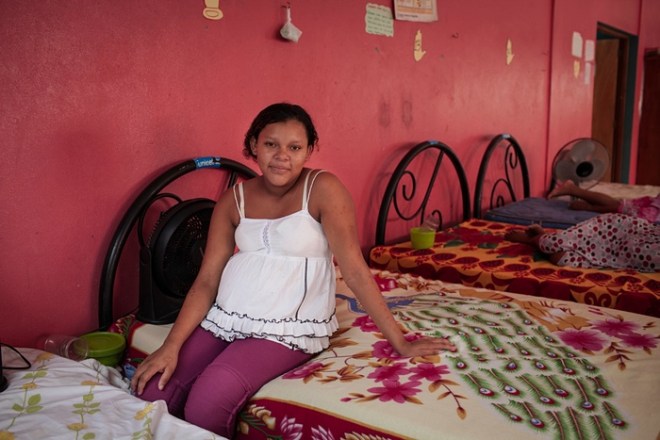
A couple of months ago, Shannon introduced the idea of gratitude journal posts here in our village, so here’s a second one, sparked by this insightful photography series by WaterAid, highlighting the differences in what women pack in their maternity bags in the different places WaterAid works.
Mother Waiting

Mother-to-be Chadla in Nicaragua, photo by Jordi Ruiz Cirera/WaterAid

What struck me most as I read through the series is the number of women who include medical/hygiene necessities in their bags for the hospital. I packed an enormous bag to take to have my first child, but now that I think about it, every single item in there was a luxury – slippers to wear for pacing the halls, a bathrobe, a book to read, music to play (I may have even brought a card game?), a journal to write in, our camera, clean clothes for me and John, etc. Even the things that seemed like necessities – snacks, juice boxes, sanitary pads, diapers, my water bottle, an outfit for Arlo to wear home – could have been easily provided or substituted by the hospital in a pinch. Some of these women need to pack clean coverings for the delivery surface, towels, basins, razor blades, string, clean water to drink, and disinfectant.
Mat Bag Contents

Malawian mother-to-be Ellen’s maternity bag contents, photo by Jenny Lewis/WaterAid

 
I’m a little sheepish admitting that I didn’t even use any of the crap in my hospital bag during labour; Arlo was too fast for that. I ate some of the snacks I brought about an hour after he was born, but a nurse would have brought me food. The private birthing room had a beautiful tub where I had a hot bath of clean water before going home that night – and if I’d needed it, they would have had a bed for me to sleep in, with clean bedding and pillows.
 
So I’m feeling very grateful this morning for the provisions made for pregnant/birthing women in the country I was lucky enough to be born in, through no merit of my own. We tend in our culture to put a lot of stress and worry around labour/delivery, especially for first-time mamas, but this bigger-picture reflection helps me to both be thankful for and confident in the situation I face as a birthing woman.
 
If this photo series touches you similarly, here’s where you can learn more about and contribute to WaterAid’s Deliver Life Initiative. There are many similar causes out there as well, such as opportunities to fund a safe birth for a mama-to-be at Kangu.org, or enable a newborn checkup in a developing country through Plan Canada. Some baby registries, like BabyList (which I used and quite liked), allow you to include contributions to these organizations as options for your family and friends. Contributions like these are just one way we can expand our village beyond those in our physical communities, and extend our support to women the world over.

Bonding – a Whole Approach to Life

I recently read this beautiful essay on how human connection – not sobriety – is the remedy for addiction. I highly recommend reading the whole thing, but if you aren’t going to, I’ll try to snapshot the key points that have sparked my thinking here:

The author, Johann Hari, explains two separate addiction experiments done with rats, the long and short of which is that the rats who were kept in isolated, un-stimulating environments were exceptionally prone to drug addiction, but those who lived in ‘Rat Park,’ a healthy, happy environment for rats, were not. Moreover, once rats who had been conditioned to addiction in the isolated cages were allowed to live in Rat Park (“a lush cage” with “colored balls and the best rat-food and tunnels to scamper down and plenty of friends”), they quickly returned to a life free of drug use. He goes on to make comparisons to human examples of Vietnam-war veterans and those prescribed heavily-addictive drugs in hospital settings, which are quite interesting.

But my thought-train here has really nothing to do with addiction per se, or with rats, or with the ethics of animal experimentation. Rather, one of Hari’s passages struck me particularly:

“Human beings are bonding animals. We need to connect and love. […] But we have created an environment and a culture that cut us off from connection, or offer only the parody of it offered by the Internet.”

His argument is about addiction as a clinical condition, but I think his assessment of human beings is something we can all reflect on and learn from.

While not in as dire circumstances as many people, there are many of us living what appear on the surface, or from the outside, to be ‘full’ and ‘happy’ lives… or at least what ‘should’ be so. In truth, many of us live in self-constructed cages of isolation. Even if we’re not facing depression or constant physical isolation, we’re often more isolated than we would like to be. Why is that, especially if we are lucky enough to in fact have the means, the people nearby, and the opportunities, to be more connected, more bonded with our village?

Too often it seems we feel we don’t have the time to connect with our people, our friends and family; this is the most common cause I hear. But what are we doing instead? The usual culprits seem to be working, getting chores done, driving around to do errands, with the awful end result that when one does have some ‘free’ time, it needs to be ‘me’ time (read: a chance to collapse from exhaustion, to sleep or zombify in front of a screen).

But I think in these cases we need to question the importance of the things we’re using our time for instead of connecting – because at the end of the day, we are choosing to do so, and only by acknowledging our own agency can we start to either change it or become okay with it.

Do our living spaces really need to be tidy in order to enjoy our home with those we love? Does our time need to be ‘free’ of obligations or to-do lists before we can engage with our people? Or would it be better if we did more things communally – buying food, cooking, folding laundry – embracing that we’re all going through this together, rather than feeling we need to ‘get our shit together’ before we can enjoy one another’s company? Do we really need to ‘unwind’ at the end of a long day by scrolling through a social media feed that only gives us that ‘parody’ of bonding? We could instead be actually connecting with the people and activities that bring us joy, or indulging in that ‘me’ time by having a bath, walking outside, or doing an activity that engages our bodies and minds rather than just collapsing from exhaustion, often in front of a screen?

We have created a culture, as Hari says, “that cuts us off from connection.” The expectation is that we will all live in our own little kingdoms, whatever your particular box of living space looks like, and that our first responsibility is to keep our own kingdom in order. If we are good at keeping this order – bringing in the right amount of money for our lifestyle, tidying and cleaning, having the ‘right’ groceries in our cupboards with our near-future meal plans settled, having at least some plans in the works for how we’ll change our kingdom/life, and maintaining whatever image we’ve created of our lives in our online worlds – then we can occasionally, when it’s a ‘good’ time, invite others into our kingdom to enjoy the space we’ve cultivated, or allow ourselves some time away from our boxes to enjoy someone else’s kingdom… provided they have kept their kingdom in order, of course.

Perhaps we need to start living with each other, instead of alongside one other with the occasional meeting in the same space.

The people we wish we bonded more with might live in the same space as us, our spouses or children; they may live down the street or across town or across the country or the world, and technology may be a necessary tool for allowing us to simulate face-to-face interactions with some of them. We may wish to bond more with ourselves, to connect with our interests, and hobbies, those experiences that allow us to feel more alive, more engaged and joyful.

The point is not how we connect but whether the connection, the bonding, is a real bond or a parody. Even more so, the point is accepting our own agency (should we be so fortunate as to have some, as there are many in the world who truly don’t), so that when we feel we’re living in a cage, we can look around and determine honestly if the bars are real, or if we’ve given them form and weight with our own perceptions.

“Bonding” in this broader sense doesn’t seem to be something that can be done or felt effectively if only allotted in rare, discrete blocks of time; such a model means there will also be set times of isolation, boredom, or loneliness. It would be idealistic to think all of life will be continuous bonding and connection, but it also seems sad and unnecessary to resign ourselves to a life plan where bonding and connection are rare ‘treats’ if we’ve been ‘good.’ I’m not sure what the solution is, but I think it’s worth some serious consideration, and I hope some of you will leave your thoughtful comments below!

1 7 8 9 11